"Esse Gesse", Death Valley, and Politics
The author reflects on childhood memories of comic books and "Death Valley" during a heatwave, connecting these experiences to a road trip and the current political landscape in Türkiye.
Dear Readers:
We are in the midst of Eyyam-ı Bahur, the Dog Days, or Hellish Heat. Since I don't like air conditioning, I feel drained and exhausted in the afternoons. I frequently take cold showers, eagerly awaiting the cool evening. It is during such days that I involuntarily recall California's "Death Valley" and my childhood years.
I'd like to share when I first encountered the phrase "Death Valley":
CIRCUMCISION
It was February 1967 (mid-year holiday). I was a third-grade elementary school student. My brother Ahmet, two years my senior, was in Iğdır. My two older brothers, Atila and Selahattin, were students at Kars High School. None of us were circumcised. I suppose my father decided to have all four brothers circumcised on the same day to get it done "cheaply and easily." When our cousin Kinyas Abi was included in the circumcision frenzy, we became a total of five "victims." In those years, I was 9, Ahmet 11, Selahattin 16, Atilla 17, and Kinyas was around 21. I don't remember if Kinyas Abi was at Kars High School then or a student at the Private Ankara Yükseliş College founded by Hacı Ali Demirel.
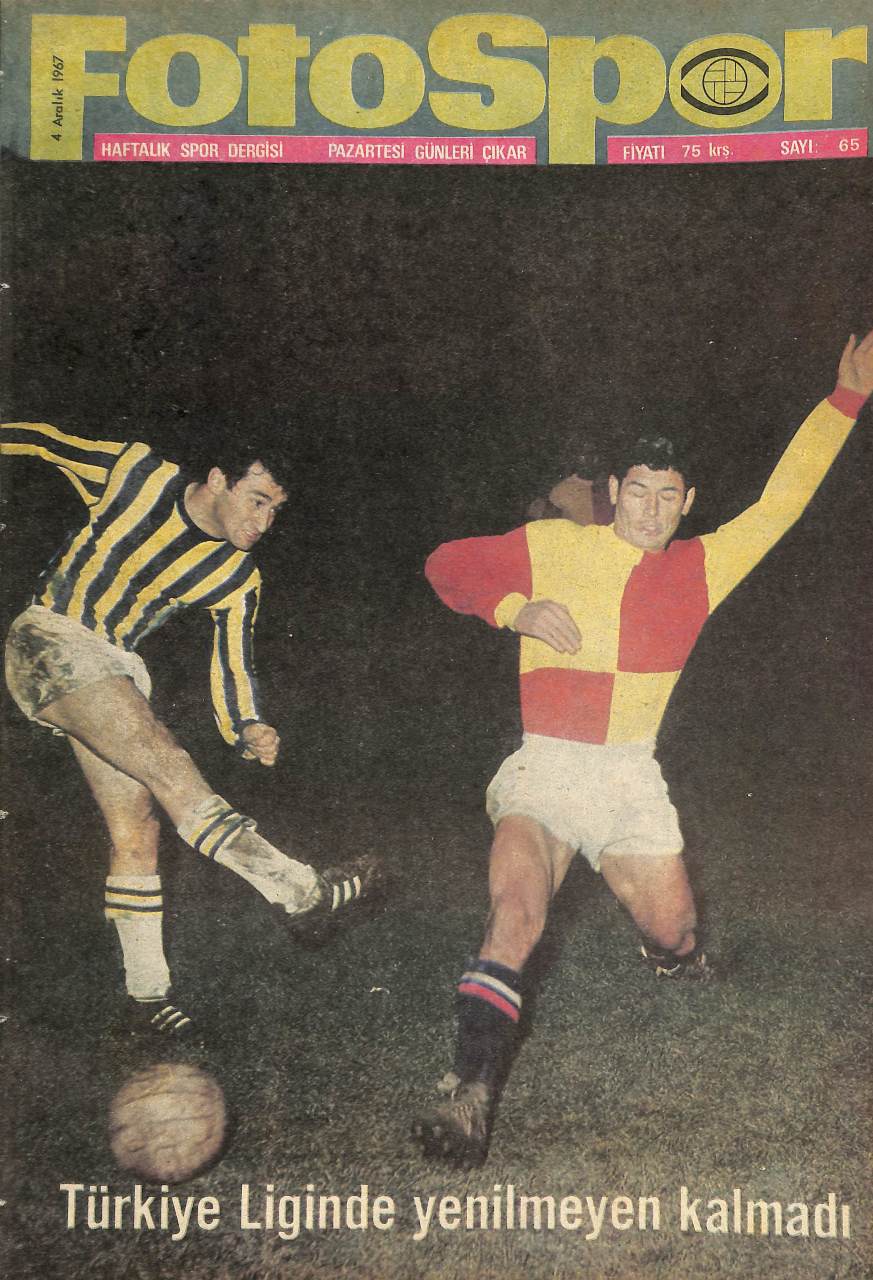
Without any wedding celebrations or ceremonies, the sharp razor of our religious teacher, who had specialized in circumcision, descended like a guillotine on our private parts. We, the "victims," were quickly executed one by one and laid out side-by-side on floor mattresses in the guest room. My two older brothers had brought comic books and a colorful sports magazine called FotoSpor from Kars. I met Texas, Tom Mix, Kinowa, and Tex on my circumcision bed. That year, Beşiktaş and Fenerbahçe were competing for the championship. Kinyas Abi was a Galatasaray fan; my two brothers were Fenerbahçe fans. Since the newspaper featured more Fenerbahçe players, I became a Fenerbahçe fan from that day on.
It was then, when I read Tom Mix from the comic books I got my hands on, that I first encountered the phrase "Death Valley." Our hero, Tom Mix, along with his cheerful friends Konyakçı and Doctor Salasso, find themselves in Death Valley while tracking a bank robber. Both they and their horses become semi-conscious from the heat; they struggle to continue their journey but soon succumb to thirst and scorching heat and faint. They are lucky. They are rescued by friendly Native American tribal warriors.
I read this book countless times, engraving every panel into my memory.
COMIC BOOKS
With circumcision, a new era began in my life: a passion for comic books and football. I spent all my money on comic books, building a collection of my own. In later years, I would also meet Captain Swing, Tintin, Zagor, Lucky Luke, Tarzan, Zembla, Tom Braks, and Superman.
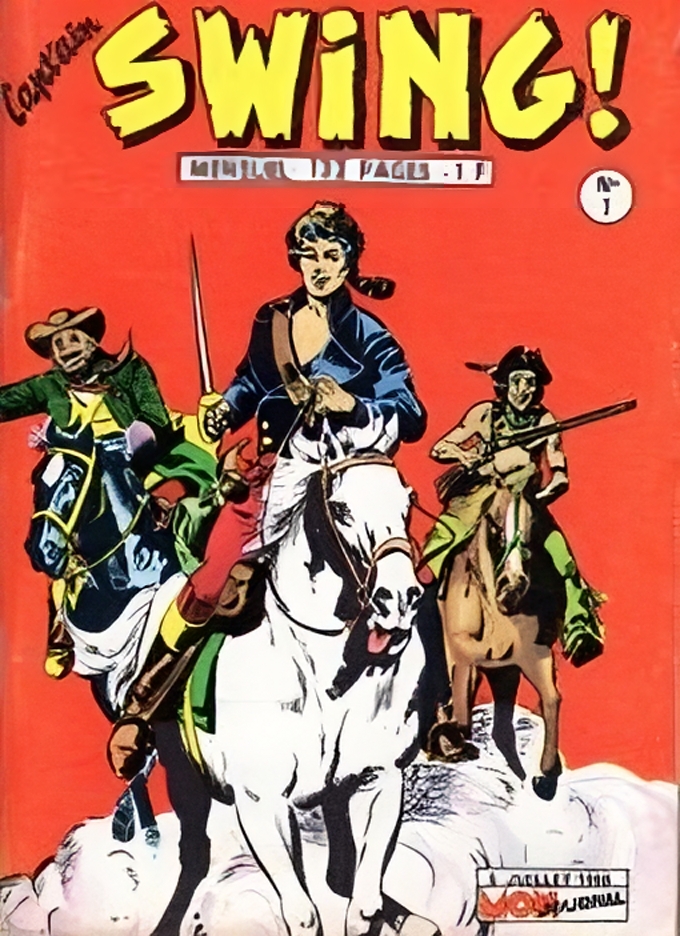
During my years in Türkiye, I had three favorites: Texas, Tom Mix, and Captain Swing. In all three, the adventures of a hero and his two inseparable cheerful friends adorned the episodes. Tom Mix and his two friends Konyakçı and Doctor Salasso; in Texas, Steel Black and his two friends Rodi and Professor; Captain Swing and his two friends Gloomy Owl and Mister Bluff (and his loyal dog Puik). Tom Mix has a fiancée named Suzy, and Captain Swing has a sweetheart named Betty, to whom he has lost his heart. However, Steel Black is shy and reserved when it comes to women.
COMIC BOOKS IN FRANCE
During my years at Kabataş Erkek High School, I drifted away from both comic books and football. This continued during my university years. Then, I found myself in France.
One day, as I passed by one of the kiosks selling newspapers, magazines, and cigarettes, Captain Swing caught my eye. I immediately bought it. I eagerly began to read it. It reminded me of my childhood years. Moreover, it also helped me improve my French.
One day, I curiously asked the kiosk owner:
"Do you have Texas, Tom Mix?"
"I've never heard those names?"
In France, I bought and read Tintin and Captain Swing with interest. One day, I stopped by a Turkish bookstore in the Faubourg Saint Denis neighborhood of Paris. When I saw Turkish Texas and Tom Mix, I bought them. I showed them to my French friend, the kiosk owner. He took them and flipped through the pages:
"Oh! EsseGesse! This one is called Blek Le Roc (Texas), and this one is Capitan Miki (Tom Mix). Unfortunately, they had a legal dispute over publishing rights. They are not currently sold in France! I suppose they will be re-published soon."
"Who is EsseGesse?"
"The ones who drew Captain Swing, Blek Le Roc, and Capitan Miki."
Since the story of Texas took place around present-day Pennsylvania and Baltimore during the American War of Independence; Captain Swing's story also took place during the American War of Independence around Lake Ontario, near the present-day US-Canada border; and Tom Mix's story took place in the mid-19th century (1850) around present-day Nevada and its vicinity, I thought these three comic books were of American origin. The locations and names were always American.
"Where is EsseGesse from?"
"It's the collective name of three Italian writers."
"So, these comic books were first published in Italy?"
"Yes!"
"How can that be, the heroes' names, the places where the events take place are American!"
My friend asked with a smile:
"Have you seen the movie Pour Une Poignée De Dollars (A Fistful of Dollars)?"
"Of course!"
"Have you seen the movie Le Bon, la Brute et le Truand (The Good, the Bad and the Ugly)?"
"Of course!"
"Have you seen the movie Il Était Une Fois Dans l’Ouest (Once Upon a Time in the West / Blood on the West)?"
"Of course!"
"Where do you think these movies were filmed?"
"In America!"
"You're wrong! All three of these films were shot in Spain and Italy by an Italian director. That's why these films are called Spaghetti Westerns."
I was surprised. My three favorite comic books were Italian productions. My three favorite movies were also shot in Spain and Italy by an Italian director.
I was curious about the three writers named EsseGesse. Three friends named Giovanni Sinchetto, Pietro Sartoris, and Dario Guzzon had named themselves EsseGesse, inspired by their initials.

The EsseGesse Team: From left to right Giovanni Sinchetto (b. 1925 - d.1989), Pietro Sartoris (b.1926 - d.1989) and Dario Guzzon (b.1926 - d.2000). Holding an issue of Texas
AMERICA
In America, I first settled in California. This was, in a sense, where Tom Mix's adventures took place. Later, when I went to the University of Pennsylvania, I settled in Philadelphia. This was where Steel Black's adventures took place. My third place of residence was the state of Texas. I would later understand that while the original name of the comic book was "Il Grande Blek," meaning "Great Blek," Turkish translators had given it the name "Texas." However, the events had nothing to do with the state of Texas.
It was the summer of 1996. My sister Leyla, who lived in Germany, and her four-year-old son Alan came to visit me in America. We set off on a South-Western American tour starting from Dallas in my new Ford Explorer SUV. Our first stop was Phoenix, the capital of Arizona. From there, we headed to San Diego. We toured the world's largest zoo by cable car. Alan stopped us at every McDonald's he saw. Each time, he devoured the hamburger and fries placed before him, happily drinking a large Coca-Cola.
After stopping at Disneyland in Los Angeles, we headed towards Nevada via San Francisco. It was time to go to Las Vegas. There were many ways to get to Las Vegas in Nevada from Northern California. The shortest was the Death Valley road. I was eager to see Death Valley, whose name I first heard in my childhood, on my circumcision bed. I turned onto the road that passed right through the middle of Death Valley. As I passed by what looked like an abandoned gas station, a sign read, "Please fill your tank before entering Death Valley!" My tank was three-quarters full. I thought to myself, "Oh! This gas will be enough. This is America. There's a gas station every 30 km."
After driving 20-30 km, I took a break. The asphalt road was empty. There wasn't a single car coming or going.

As I continued on the road, I explained to Leyla:
"When the Gold Rush in the West began in 1849, Americans from the East chose Death Valley, the shortest route, to reach the West, i.e., California, but hundreds died. That's why they named this place Death Valley. Death Valley is 80 meters below sea level. That's why it's one of the hottest regions in the world."
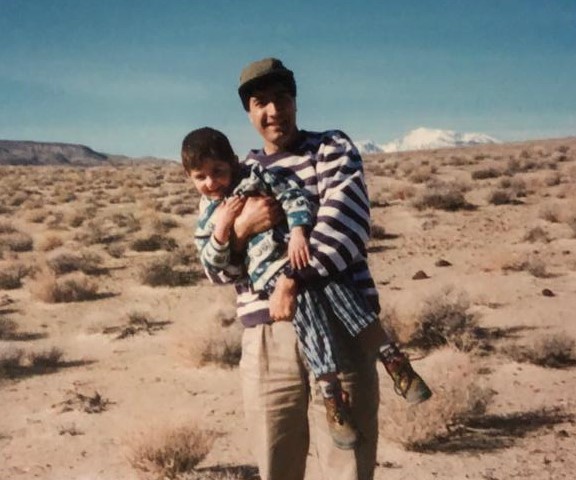
Mücahit & Alan at the entrance of Death Valley Leyla at the entrance of Death Valley (looking cheerful for now)
After driving 40-50 km, the thermometer in my car started showing 112 Fahrenheit degrees (50 Celsius). We didn't dare open the window. My gas was rapidly depleting. It seemed as if the car was burning gas in direct proportion to the heat. There were no gas stations around. The fuel gauge hit zero. We had driven 100 km but hadn't encountered any cars or gas stations. Panic seized me. I tried not to let Leyla notice. The gauge was now fixed above zero. If we ran out of gas, we would certainly be harmed in this heat. There were no cell phones back then. I continued to drive, not knowing how to ask for help. The red light indicating low fuel started flashing. The car could stop at any moment. At that moment, I saw a building in the distance. It looked dilapidated and precarious. This time, the precarious-looking gas station seemed like a savior to me. How happy I was. An old woman started the gas station pump by turning a handle with a primitive method, filling the tank. She laughed:
"Those who enter Death Valley from this side for the first time disdain my gas station and don't buy gas, but those who cross Death Valley from end to end, like you, see me as a savior. Heh! Heh! Heh!"
I gave a generous tip, and we set off towards Las Vegas.
POLITICS
Politics is also like a comic book. Every political party has a hero and a story to tell. I suppose readers are now tired of the heroes of existing comic books (parties) and the stories they keep repeating. The people of Türkiye seem exhausted from traveling through Death Valley, that is, the scorching heat of politics... I suppose it's time for new comic books to be released. Let's hope for the best!
ANECDOTE…. ANECDOTE…. ANECDOTE…. ANECDOTE
I FELT SORRY FOR YOUR SITUATION
Hamit Hun is careful to fulfill his religious duties and obligations. One Ramadan, coinciding with Iğdır's relentless heat, he cannot go without drinking water every day and cannot fast. Thus, a fasting expiation arises. He has three options to atone for his sin:
- Fast for 60 consecutive days
- Feed 60 poor people in one day
- Feed 1 poor person for 60 days
When the hoca learns that Hamit Hun is looking for a poor person for his expiation, he eagerly interjects:
"Mr. Hamit, you won't find anyone poorer than me in this neighborhood. I'm in great need. I spend the money I receive on mosque expenses. No one gives fitra or zakat!"
Hamit Hun agrees to give his expiation to the hoca, and the hoca is delighted.
The next day, the hoca goes to breakfast with great excitement. Dry bread and tea are placed before him; he goes to lunch, dry bread and water are placed before him; he goes to dinner, dry bread and water are placed before him again.
The hoca rebels against this situation:
"Mr. Hamit, it is a sin to feed a poor person with dry bread."
Hamit Hun:
"Hoca, when I saw no bread at your kebab feast, I felt very sorry for your situation. Since I thought you were longing for even a piece of bread, I gave you bread for three meals. If you wish, I can cut out the bread starting tomorrow."
CRAWLING
Hamit Hun is walking home from the market with his neighbor. His neighbor confesses:
"Mr. Hamit, I have sinned against my wife, now with what face will I go home, how will I go?"
When Hamit Hun hears the word "sin," he falls silent, forgets the conversation, and his mind drifts to what is written in the Holy Book. He begins to think about fate, the apocalypse, and the afterlife. Before his eyes appears the Sirat Bridge, thinner than a hair and sharper than a sword, stretched over the blazing fires of hell. People have been resurrected, queuing before the Sirat Bridge... Believers who are not sinners are lucky. They cross the Sirat Bridge at lightning speed. Those with a few sins cross at wind speed, those with more sins at horse speed, and those with even more sins crawl along. The complete sinners tumble right and left into the flames.
Hamit Hun walks and tries to guess what situation awaits him on the Sirat Bridge. He counts his sins and good deeds, evaluates them, makes his decision, and says aloud how he will cross the Sirat Bridge:
"Crawling!"
The neighbor is surprised: "Crawling?"
"Yes, yes!" Hamit Hun confirms.
Late in the evening, Hamit Hun's door is knocked. It's the neighbor's wife:
"Mr. Hamit, I don't know what happened to my husband? He came home crawling."
"He was lucky! What if I had fallen into hell! Then he would have come home burning."
The following two tabs change content below.