World War and Game Theory
This article discusses the current global political climate through the lens of game theory, drawing parallels with historical events like World War II, and shares a personal story of Claudette Aras, Iğdır's first American bride, and her artistic protests against war.

Dear Readers:
The Israel-Hamas war continues with full intensity. "Anti-Semitism," or hatred of Jews, has gripped the entire world. Interestingly, the country where this wave is felt most strongly is the USA.
I say "interestingly" because the USA is both the country where the Jewish lobby is strongest and where anti-Jewish demonstrations are most widespread. Many universities are forced to suspend classes, and exams are postponed. Tensions, altercations, and arguments are endless in workplaces, neighborhoods, civil society organizations, and even among actors and actresses in Hollywood.
Intense anti-Semitism is not new to the world. Hitler placed anti-Jewish sentiment at the center of his political strategy. In his book Mein Kampf (My Struggle), the first volume of which was published in 1925, he blamed Jews for the lost First World War and the economic crisis, stating, "Germany and Europe will not find peace and comfort until they are cleansed of Jews," thus foreseeing the "final solution" for Jews, meaning "total annihilation." He remained true to his word. As soon as he came to power, he opened the Dachau Concentration Camp on March 22, 1933, and began hunting Jews.
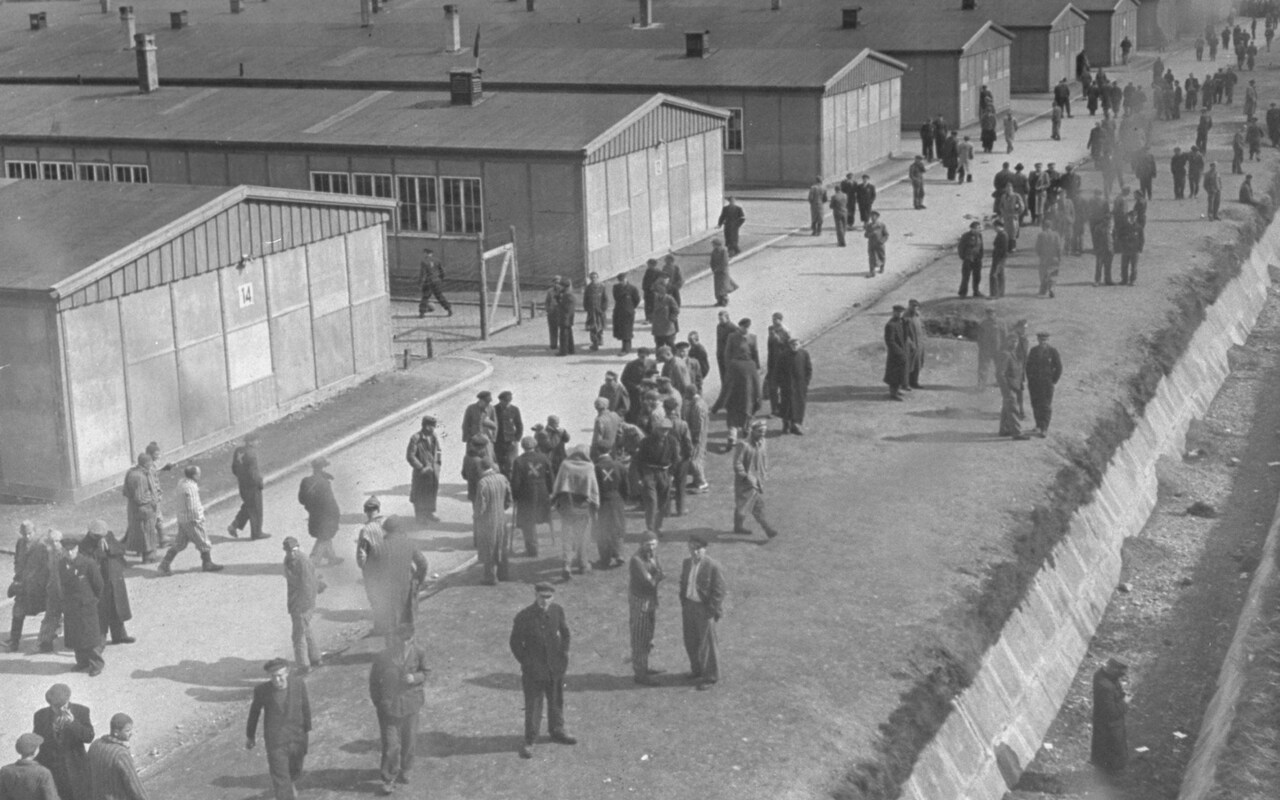
The first Nazi concentration camp: Dachau Concentration Camp
Soon, anti-Semitism embraced all of Europe. Countries with Jewish populations, in a sense, surrendered their countries to Hitler by saying, "Save us from the Jews." Hitler skillfully used anti-Semitism propaganda to quickly gain control of continental Europe. As anti-Semitism propaganda spread, the world spontaneously divided into two camps. The Second World War had become inevitable. In short, anti-Semitism became an excuse for a world war.
Today, whether justified or not, we are facing a wave of anti-Semitism propaganda. Superpowers are divided into two: on one side, the USA, the European Union, NATO, Japan, South Korea, Taiwan, India; on the other side, Russia, China, Iran, Pakistan, and North Korea. Everything depends on a spark. Although the Russia-Ukraine war had slowly begun to reveal the fronts, now the alignments are very clear. Even countries like China and North Korea, which have no Jewish population, incomprehensibly voice anti-Jewish sentiment in their state media, accelerating this polarization.
On the other hand, many countries, including Türkiye, are treading carefully and avoiding taking a clear stance. Türkiye, a NATO member, faces a difficult dilemma, just as it did during the Second World War. Its only hope is to activate mediation diplomacy at an opportune moment, thus avoiding taking sides.
For now, the great powers are putting forward groups or states loyal to them as "pawns," using them by proxy (proxy war), thereby testing the strength of the opposing side and, in a sense, understanding their own shortcomings and trying to quickly remedy them.
It is at such times that the "Game Theory" developed by the famous mathematician John Nash comes to mind.
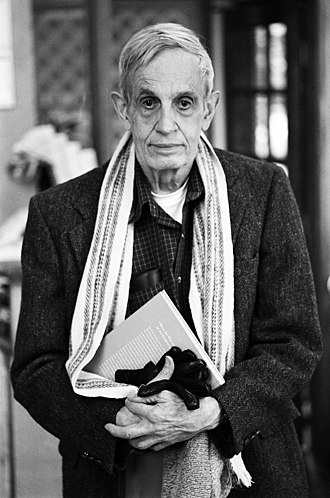
The famous mathematician John Nash, who finalized game theory
WHAT IS GAME THEORY?
David Ruelle summarizes game theory in his book "Chance and Chaos" as follows:
"Suppose we are on a battlefield with multiple shelters. I am in a shelter, and you are circling directly above me in a plane, looking for an opportunity to drop a bomb on me. Normally, to protect myself from the bomb, I should choose the strongest shelter around me and hide there; and you, normally, the smartest thing you can do is to bomb that shelter, assuming I might have chosen the best one. Knowing this, shouldn't I choose the second shelter, which doesn't seem as strong? If both of us are very intelligent, we will follow strategies based on probabilities. For example, I would look for shelters around me that offer the highest chance of survival, and then I would flip a coin or use a list of random numbers to decide where to hide. You, similarly, would use probabilities to determine the shelter where your chances of hitting me are highest. This might seem absurd to you, but if both of us can act rationally, this is what we would do. Naturally, if I don't conceal my movements, your job becomes easier; conversely, you should try not to let me know where you plan to bomb."
Game theory was first used in economics, especially in oligopoly markets (situations where there are many firms selling the same product).
Let's consider two car manufacturers, A and B: Suppose both firms are racing to be the first to launch an electric car. Firm A believes that if it takes the first step and launches the car, it will capture the entire market share. However, it has a concern: if Firm B acts quickly and enters the market after developing a better electric car, will this situation be to its advantage or disadvantage? Perhaps Firm B has no project to develop the car. If this is true, the one who brings the first product to the market will profit. In such situations, Game Theory comes to the rescue. If both firms wait for "the other side to make the first move," a "balance" will spontaneously emerge. This time, another problem arises: will neither Firm A nor Firm B agree to be "in balance" after so much expense? Will they just remain without launching their cars?
In such impasses, Game Theory is consulted today, and solution possibilities are evaluated.
***
During the Second World War, there were no atomic bombs or long-range nuclear-tipped missiles. Therefore, game theory did not find application in international politics. Besides, the theory itself was not yet fully developed in those years.
Currently, superpowers are fixated on game theory. The question of whether making the first nuclear move will be profitable or detrimental has pushed the parties into deep calculations.
A week ago, Iran openly threatened, "If Israel attempts to invade Gaza, we will strike with missiles." Israel invaded Gaza, but there is no sound from Iran. The reason for this is not "cowardice," but Iran's inability to predict the outcomes predicted by game theory.
In short, the fate of the world and humanity is currently reduced to Nash's "game theory."
PART TWO
GREETINGS TO ALL FROM CLAUDETTE ARAS, IĞDIR'S FIRST AMERICAN BRIDE
Readers who have read my book "Mazlum and Claudette" know who Claudette Aras is.

For those who don't know, I would like to add a short note:
In the Iğdır of yesteryear, a wealthy Azerbaijani merchant named Bağır Aras led a flamboyant life. He was determined to send his son, Mazlum Aras, born in 1924, to the best schools. Bağır Aras sent his son Mazlum, who completed primary school in Iğdır, to Saint-Joseph French High School in Istanbul.
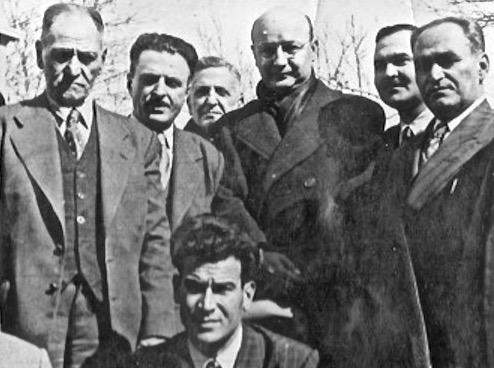
(From left to right) Bağır Aras, Nihat Erim (CHP Secretary General) in the middle with glasses, Rıza Yalçın (Iğdır CHP District Meeting, 1950) on the far right. Note: At this meeting, Rıza Yalçın was elected CHP District Chairman in place of Bağır Aras.
Mazlum attended middle and high school as a boarder at this school. He gained admission to ITU Mechanical Engineering. After graduating, he won a scholarship from the Ministry of National Education and went to the USA. He met Claudette and married her. Mazlum was the first student from Iğdır to go to the USA. For this reason, his marriage to Claudette created excitement in Iğdır. In the Iğdır of the 1950s, the names Mazlum and Claudette adorned the dreams of Iğdır residents like fairy tale heroes. The couple had two daughters named Aysel and Nuran.
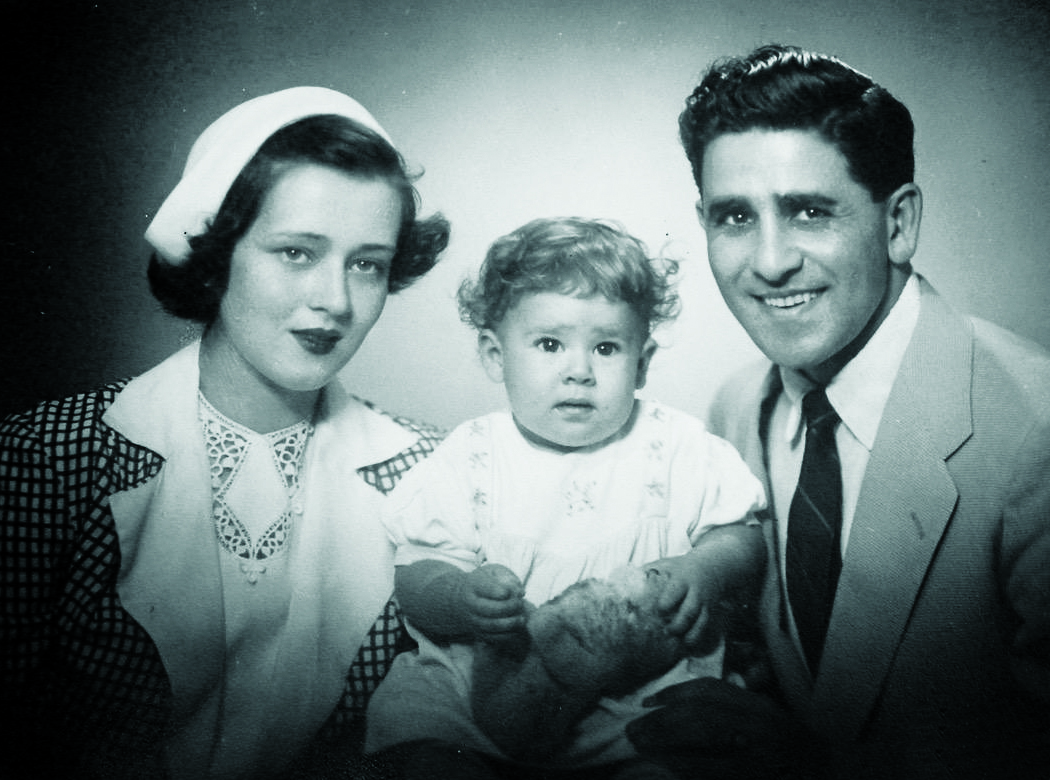
Claudette, Mazlum, and their daughter Aysel
Mazlum Aras passed away on March 20, 1980, from a heart attack. His ashes were scattered into the Atlantic Ocean from a buoy in Florida.
Claudette, born in 1932, lives alone today in Oregon State, with her life partner Edgar, in a house isolated from people, in a forest.

Claudette
I regularly correspond with 91-year-old Claudette. In her last email, she sends warm greetings to the people of Iğdır. She is very sad because she lost her cat, Neko. Neko lived for 19 years. A long life for a cat. Tearful Claudette bids Neko farewell on her last journey by leaving her unburied on a mountaintop, just like in Native American tradition.

Neko, roaming in the forest with a deer she befriended
Claudette, while caring for her life partner Edgar, who is losing his eyesight, continues to create new works of art with stained glass (fixing colored glass pieces with lead). These days, she is preparing for winter. She orders wood for the fireplace and does autumn cleaning in her garden.
Claudette is very saddened by wars, especially the Israel-Palestine war. She remembers the days of the civil war in Lebanon, where she once lived with Mazlum. The memories of those days when they had to flee, leaving their home and belongings as they were, are still vivid in her mind…
Claudette, rightly, fears that the war could escalate into a regional or world war at any moment. "Horrible, unthinkable situation! Man's inhumanity to Man never ceases," she says, rebelling against humanity's indifference.
In her latest stained-glass work, Claudette protests wars. In this work, a huge, ugly creature representing narrow-mindedness, fanaticism, cruelty, and war-mongering intimidates innocent anti-war people with lightning bolts of death. The Sky God and the birds are angry… Helpless… Just as we are helpless in the face of real war…
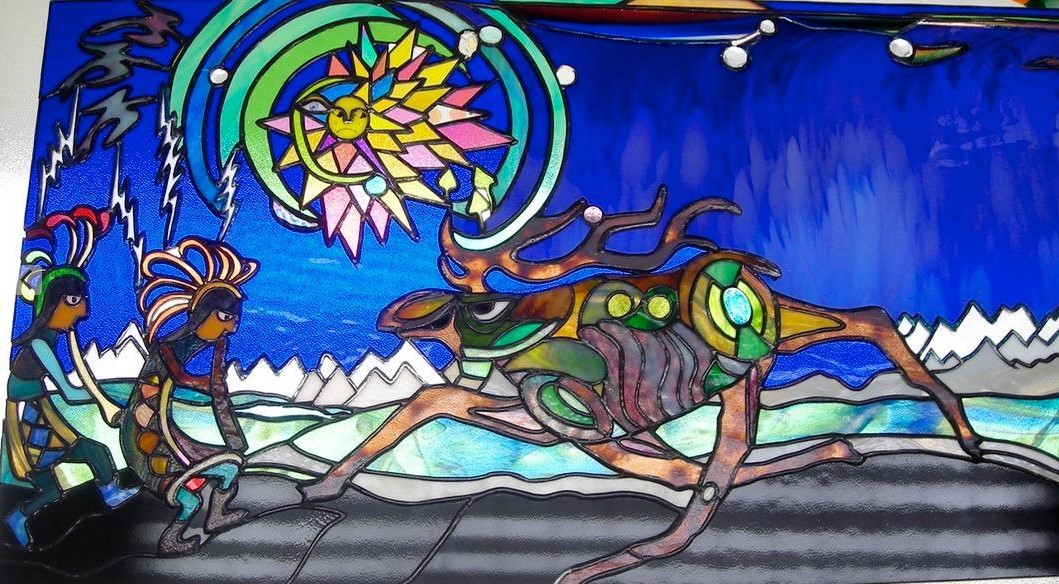
Claudette's latest stained-glass work protesting wars
Claudette has previously created stained-glass paintings with political messages. One of these is her work titled "The 4 Horsemen of the Apocalypse." In this stained glass, she names the four horsemen she depicts from left to right as: Black Lives Matter, Covid, Trump, and Global Warming. In the background, the city on the hill represents Washington D.C., the capital of the USA, under the name "The shining city of the hill." Claudette used thousands of glass pieces for this massive work. I would also like to state that she achieved all this in her 90s, indicating that there is no obstacle to creativity.
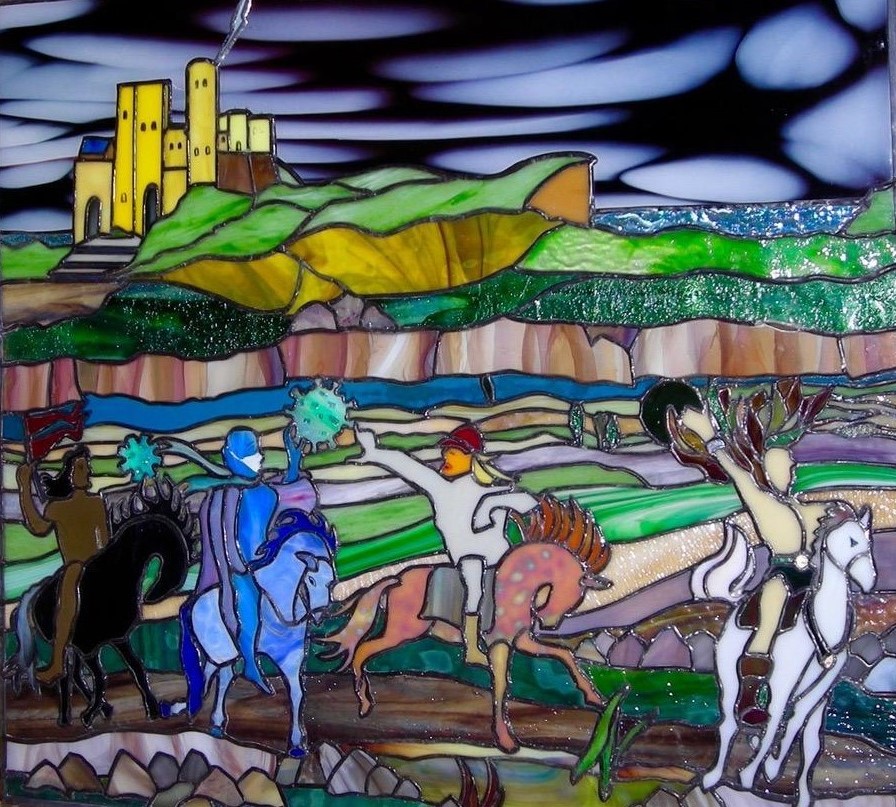
Ms. Claudette's famous work with a political message: The Four Horsemen of the Apocalypse
Claudette has signed many works symbolizing the painful days of humanity. One of these, perhaps the most heartbreaking, is her stained-glass work titled "Cry me a lilly." Reminiscent of the commonly used English idiom "Cry me a river" (Cry as much as you want), the meaning of this work, which she named "Cry me a lilly," can be translated as "Cry a lily full!" It is a meaningful work that summarizes what is happening in our world today.

Claudette's stained-glass work "Cry me a lilly"
***
Claudette shares pictures of her daughter Nuran's cat, Snowy, trying in a way to forget her longing for her beloved Neko, whom she recently sent to eternity.
I send a hug full of love from Iğdır and Türkiye to Ms. Claudette and her daughters Aysel and Nuran.

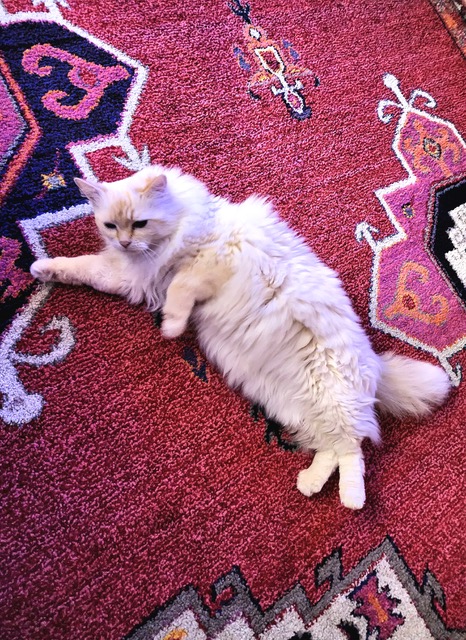
Claudette's daughter Nuran's cute cat Snowy