The Innocence of Children and Deadly Discrimination
This essay explores the lasting trauma of childhood discrimination, recounting a vivid dream that resurfaces the author's painful experience of ethnic prejudice in a 1960s Turkish school.
Dear Readers,
Life flows by quickly. Many painful and traumatic events that we thought we had forgotten are buried in our subconscious down to the finest detail, remaining hidden there. When the time comes, they revive without our awareness, making us relive the past.
DREAM
It was close to midnight yesterday (July 10). I said to myself, "It's time to put a new article on my column," and after some thought, I began to write a suitable piece, or rather, to move my fingers across the computer keys. However, as the stomach discomfort that had been bothering me for several weeks intensified, I lay down in bed without being able to finish the article. Seeing that I was having trouble sleeping, Şeval mixed fresh basil and yogurt in a blender and prepared a frothy ayran. The ayran, I suppose, must have had an effect, as I fell asleep without realizing it.
This morning (July 11), I woke up crying. It was the first time I had such a dream. My dream was as follows:
Having returned from abroad, I am nostalgically wandering through the center of Iğdır, from which I had been separated for many years... In the very middle of the city, where today's Governorship Building (Hükûmet Konağı) stands, a colossal stadium is being built... One of the most beautiful stadiums I have ever seen... Its walls have risen, adorned with lion figures... As a Fenerbahçe fan, I complain to my friend next to me, saying, "They are discriminating. It's not right for them to engrave Galatasaray's symbol on the stadium!"
Suddenly, I turn around and look towards the Iğdır High School building. This building, where I attended middle school, is to be demolished, and a new one will be built in its place... I enter the emptied building. I go into one of the classrooms and sit down. I come out crying. I lie down on the ground, stretched out in front of the building. I am sad. One of the young teachers, not from Iğdır, who is running a fundraising campaign for the new high school building, approaches me and gently warns me, "Sir, please move away from here! The building will be demolished soon," but I stubbornly retort, "No, I cannot leave! I experienced a trauma here, in this building, during my childhood years, and I cannot leave without settling accounts with this trauma."
The young teacher asks curiously:
"What kind of trauma?"
And I recount in full detail to the young teacher the trauma I experienced years ago and thought I had forgotten.
"I was a second-grade student at Iğdır Middle School. Although there was a 'HIGH SCHOOL' sign above this building, in my time, middle school students also took classes in this building or in the barracks you see further ahead. So, middle school and high school were together. I was an average student, but not very lazy. My father was the CHP District Chairman. He was one of the prominent Kurdish figures. My family was known as leftists. An Azerbaijani teacher named S.B. taught our English class. Years later, I learned that even back then, S.B. was one of the important figures of the Ülkücü (Idealist) movement. A significant number of Ülkücü and nationalist Azerbaijani teachers openly discriminated and treated innocent Kurdish students badly. I also got my share of this. At the end of the year, I failed English and had to take a make-up exam. My other grades were above average, but I had failed English with a '4'. In those years, one needed at least a '5' out of '10' to pass a class. The bitter truth was that our teacher did not know English. The majority of the class were Azerbaijani students. I was the only one who had to take a make-up exam in English. Years later, I would realize that it wasn't a 'lazy student' who was left for a make-up exam, but his leftist and Kurdish father, 'Mecit Hun'. My English teacher, S.B., had decided to take revenge on me for his hatred of my father and my family. And he succeeded.
My family was semi-nomadic. We spent the months of May to September in the Güngörmez or Zor plateaus. The make-up exam was in August. To take the exam, I came to Iğdır from the Zor plateau with great difficulty. I took the exam. Our teacher, S.B., was patrolling the exam hall. Apparently, he would be grading the exam papers. When I got a '4' in English again, I failed the class and lost a year. I repeated the second grade of middle school. Since my friends, whom I loved, continued to the third grade, my failing the class caused a deep wound in my heart, whose pain would last for years. I am crying because I remember this trauma."
The young teacher listens carefully. He helps me up by holding my hand. He hugs me warmly.
At that moment, I woke up. It was 6 AM. I thought about my dream. What I saw in the dream was what I had actually experienced. This trauma caused by discrimination, which I thought I had forgotten, was still haunting me after 50 years. Who knows how many other Kurdish children from Iğdır, like me, have been exposed to traumas caused by discrimination, perhaps silently crying out with this suppressed pain in their hearts:
"Give an account for the trauma you inflicted upon me!"
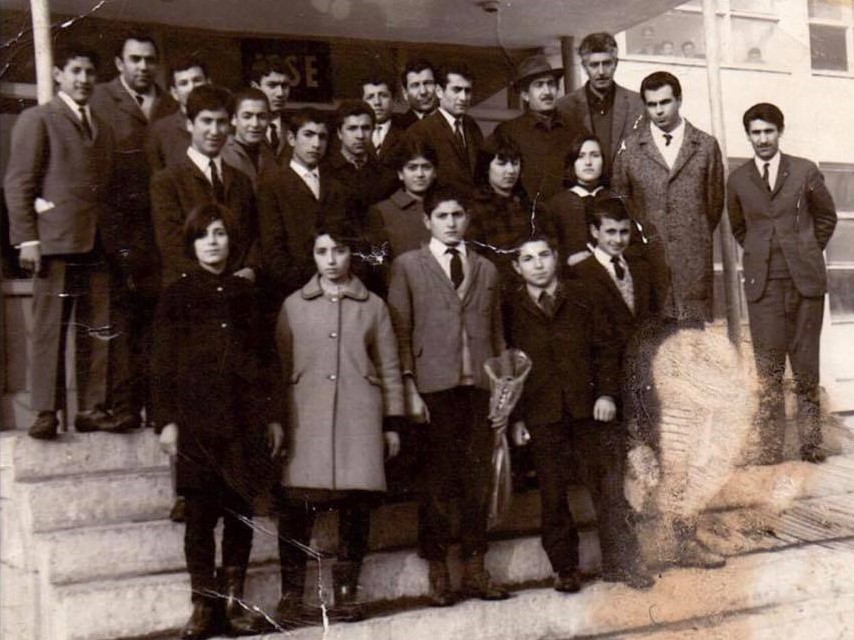
(This picture was taken from the Facebook archive of my esteemed elder brother, Ahmet Balamir. I extend my love and respect to him.)
NOTE: This picture was taken in February 1967. As you can see, only 'LİSE' (HIGH SCHOOL) is written on the building. These were the years when the high school opened in Iğdır. However, in those years, middle school students also took classes in this building. In the picture, the tallest person at the back, on the right, is my father, Mecit Hun. (In the back row, standing, second from left is Mehmet Yılmaz, immediately to the left in front of Mecit Hun is Emin Akyıldız)
My father is in this picture in his capacity as the President of the Iğdır High School Establishment Association, posing with successful students and teachers. My father, who graduated from Erzurum High School with honors, taught Mathematics and Physics at Iğdır Middle School (there was no high school in those years), which operated in an adobe building on the site of today's Iğdır PTT building in 1944-45 and 1948-49. Because he could not enroll in Ankara Law Faculty, which he desired, due to a criminal record of "being a Kurdist" by Hüsnü Bingöl, he spent his time teaching at Iğdır Middle School until he went to the military in the 1944-45 academic year. These were the years of World War II. After returning from four years of military service, he again taught for a short period at the middle school in the same building. My father did not inquire about or question his children's academic performance. We, the children, also did not dare to speak to our father due to excessive respect. Perhaps some of my compatriots might think of us, Mecit Hun's children, as follows: "No one would dare to wrong them!" This assessment is not correct. Like other Kurdish children, we too were helpless in the grip of discrimination.
The following two tabs change content below.