The Triumph of Will: Yusuf Akgün (Part Five)
Yusuf Akgün recounts his harrowing escape from a children's home in Trabzon to the streets of Istanbul, and his subsequent transfer to a dysfunctional children's home in Ağrı, where he faced abuse and planned his eventual escape to Iğdır.
FROM THE CHILDREN'S HOME TO THE STREETS
Trabzon was, after all, a provincial and distant city. Children raised in the Children's Protection Institutions in central Ankara knew their rights and would bravely remind officials of them when necessary. However, the situation at the Trabzon Children's Protection Institution was different. The residents there did not know their rights and silently endured injustices. But I would not accept this situation; I would resist the officials, arguing and defending my rights.
My outspokenness was not well-received. A threat and warning were inevitable:
One day, two older boys I lived with in the same dormitory took me to the bedroom. One held me tightly, while the other began to cut my body with a razor blade he held. Grinning, he said, “Let this be a lesson to you! If you do it again, we’ll cut your throat.” I still bear these cruel razor marks on my body and remember the horrors of that day.
After this incident, I remained silent for a while. As the pressure increased, my friend Ümit and I decided to run away. I was 12-13 years old.
ESCAPE TO ISTANBUL
Since Trabzon was on trade routes, trucks were connected to other cities. Goods usually arrived from Istanbul by ship and were transported by truck to Eastern and Southeastern Anatolia. Some trucks also traveled directly to and from Istanbul.
It was late afternoon. As Ümit and I wandered aimlessly and miserably through the streets of Trabzon, an old man approached us. Seeing that I was disabled, he couldn't help but ask:
“Children, what are you doing on the street?”
“Uncle, they kidnapped us and brought us here. Our family is in Istanbul.”
He was a good man. He took us to a restaurant frequented by truck drivers. He fed us. He explained our situation to his colleagues and collected money.
Then the man turned to us and said goodbye, "A friend will take you." Ümit and I were uneasy about this. We thought someone would take us to the police and hand us over. Only one option remained: to escape.
We secretly climbed into the back of an empty truck with license plate number 34. The truck took us to Istanbul.
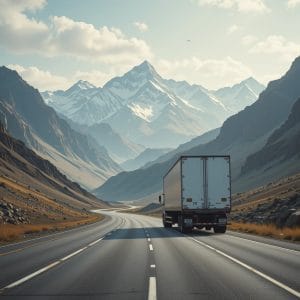
Yusuf and Ümit hid and traveled in a truck from Trabzon to Istanbul.
***
Ümit was a Galatasaray (GS) fan. He knew that GS footballers trained at the Florya Facilities during the week. He wanted to see them. We found a way to get to the Florya Facilities. Ümit watched the footballers with great admiration, shouting constantly.
After a while, our money ran out. The weather also started to get cold.
There was a place in Esenler where food wholesalers were located. Trucks from distant cities brought goods here. Ümit and I would wander around the food market during the day, working here and there, earning money. The hardest thing was finding a warm place to sleep. There was a mafia that profited from street children. Their method was as follows:
Since the engines of trucks coming from long distances were warm, when a truck parked, cardboard sheets would be laid under the truck engines, and this spot would be rented out to street children for money as a place to sleep. We would lose the money we earned during the day to this mafia network just to be able to sleep for a few hours on cardboard under the warm engines. To be honest, in cold weather, our greatest comfort was being able to sleep under a warm engine. Those who couldn't afford this would huddle in a corner, shivering and cuddling together to try and sleep.
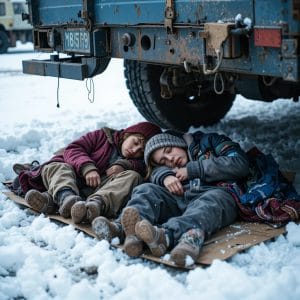
For street children, the ideal place to sleep was under a truck.
***
One day, police officers surrounded me. They questioned me. When they realized I had run away from the dormitory, they took me to the center. They took care of my hygiene for a few days, and then sent me back to Trabzon.
The dormitory administrators in Trabzon were not happy about my return. For them, I was someone who constantly caused problems and disrupted order. They decided to remove me.
The closest children's protection institution to Iğdır was in Ağrı. They sent me to Ağrı.
MY DAYS IN AĞRI
When I entered the Ağrı Children's Protection Institution, I was shocked by what I saw. Living on the street seemed more appealing and acceptable. Everything in the dormitory was broken and dilapidated. The place was overrun with dirt and clutter. The officials were also troubled individuals, devoid of human feelings.
There were about 90 children in the dormitory. The officials, supposedly to maintain discipline, had found a form of entertainment for themselves. An official would enter the room and order the other children to attack the child they had targeted. The place would instantly turn into chaos, and the targeted child would be stripped naked and thrown out of the dormitory. The official would take great pleasure in this, laughing heartily.
Coming to Ağrı had deeply shaken me. In a sense, I had become alienated from society and withdrawn into myself. One day, a teacher handed me a piece of paper. He wanted me to give it to the dormitory administration. The paper stated that I was a withdrawn child. This observation, of course, reflected the truth.
I had not forgotten Kurdish. The officials in the dormitory usually spoke Kurdish among themselves. I understood them but didn't let on. They, assuming I didn't know Kurdish, spoke as they pleased.
The officials had established a protection racket system. They used the children for their purposes and seized the money earned. Because I resisted this, I was frequently punished.
The state would give pocket money to the students in the dormitory. The officials would also covet this money and forcibly take it from us. I would resist this too. When that happened, punishment became inevitable. They would either not give me food or lock me in the dormitory's single toilet for more than a day. It was on such a day that I began to plan my escape from the dormitory to Iğdır.
Iğdır's license plate number is 76. Some days, I would lean against the dormitory wall and fix my gaze on the cars passing by. License plates with the number 76 would stir an excitement within me. I would feel as if Iğdır was calling me back. My father's happy expression while working on house constructions, and the days I walked on muddy ground, would pass before my eyes.
Some days, when I walked in the dormitory garden, my shoes would sink into the mud. I would carefully put this mud into a bag and keep it in my locker. These dried pieces of mud reminded me of my childhood days in Iğdır.
I was a young man of 16-17. The pains I had endured and the exiles they had subjected me to had left deep wounds in my heart. I had learned to look at life with a mature perspective, but I couldn't free myself from the childhood memories lodged in a corner of my mind and the longing for my nuclear family.
I made several escape attempts, but the gendarmerie caught me and brought me back to the dormitory. There was no one left who didn't know me. Whenever I moved away from the dormitory, the gendarmerie would be informed.
Meanwhile, I must state a fact: The state took care of us within its means. Students staying in the dormitory were given pocket money, and those attending school were provided with notebooks and such.
I will never forget that when I went to school in Ağrı, most of my classmates came from poor families. They didn't have notebooks to write in. I, however, had four sturdy notebooks. I kept them carefully. I would dream of returning to Iğdır one day and proudly showing my notebooks to my father. Also, on holidays, residents of the dormitory were allowed leave on the condition that a family member came to pick them up. Occasionally, the state would also donate items like clothes and bags. The cunning ones would take these out and sell them. I, too, would save my belongings, hoping to show them to my father one day when I went to Iğdır and make him proud.
It was winter. My friends from Patnos and Tatvan and I made an escape plan. The dormitory had a central heating system. The boiler was faulty. It kept making a constant thumping sound. Taking advantage of this, we broke the locker doors in the middle of the night and stuffed our belongings into our bags. We secretly escaped from the dormitory. Since I wanted to go to Iğdır, my friends and I parted ways. As I walked in the snow, I saw a bridge in the distance. The weather was cold. A freezing wind blew harshly, making me shiver. I took shelter under the bridge. Somehow, I fell asleep.
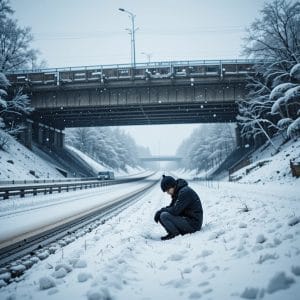
Yusuf falls asleep under a bridge.
A domestic cargo vehicle heading towards Iğdır stops at the bridge. The driver needs to use the restroom. He goes under the bridge.
When he saw me lying there, he called his friend. Together, they put me in the car and wrapped me in a blanket. "I'm from Iğdır. I was kidnapped," I said. After all, I had street experience from my days in Istanbul. This is how we arrived in Iğdır. The cargo company handed me over to the gendarmerie.
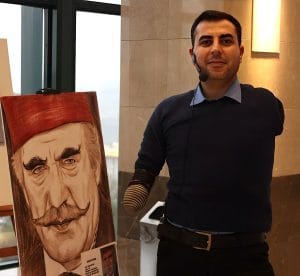
Yusuf Akgün's portrait of Hulusi Kentmen, drawn by holding the pen with his mouth.
END OF PART FIVE