Azeris and Kurds Are Two Brotherly Nations
This essay explores the historical and cultural ties between Azeris and Kurds, emphasizing their shared past and the importance of maintaining peace and cooperation despite political tensions.

Dear Readers:
Azeris and Kurds are two brotherly nations intertwined. The mutual interaction between the two peoples has been observed in many areas throughout history and has profoundly shaped the social, cultural, and historical fabric of both societies.
Throughout history, Azeris and Kurds have often been part of the same state structure and witnessed common historical events. This has created deep historical ties between the two peoples and allowed for the development of mutual understanding. However, politics, or more accurately, "political ambition," can sometimes pit these two brotherly peoples against each other. Interestingly, similar tensions due to political rivalry were experienced in Urmia and Iğdır, where Azeris and Kurds live together, during the elections held in Iran and Turkey in the last month.
On March 1, 2024, elections for the Assembly of Experts and Parliament were held in Iran. In the Urmia province, where Azeris and Kurds live together, Kurds won 7 of the 12 parliamentary seats, while Azeris won 5. The incidents that occurred between Azeris and Kurds during the election victory celebrations served as a serious warning.
This time, the tension experienced before and immediately after the local elections held in Turkey on March 31, 2024, also had a characteristic that, in a sense, recalled Urmia.
Yet, the geographies of Azerbaijan and Kurdistan have been scenes of trade, migration, and social interaction for many years, allowing both societies to become familiar with each other's culture, language, and traditions.
THE AZERBAIJAN NATIONAL GOVERNMENT AND THE MAHABAD KURDISH REPUBLIC
There is no need to delve deep into history. At the end of World War II, the "Azerbaijan National Government" was established in Southern Azerbaijan, with Tabriz as its capital. Simultaneously, the Mahabad Kurdish Republic was declared, with Mahabad city as its capital.
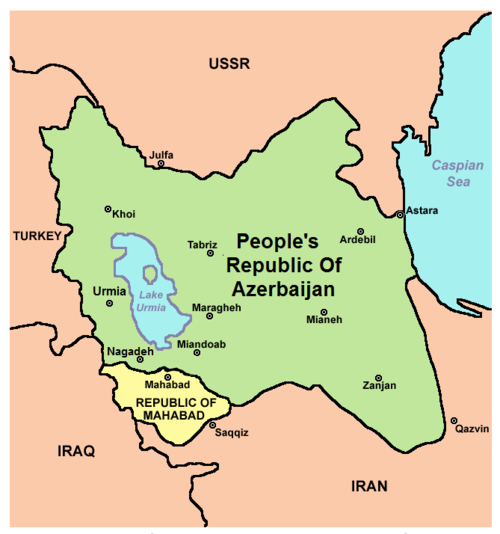
The Azerbaijan National Republic (green) and the Mahabad Kurdish Republic (yellow) established in 1946
Both Republics signed an agreement on May 3, 1946. I present the articles of this agreement as they are, serving as a warning to those who wish to pit Azeris and Kurds against each other these days:
- Representatives of each party shall be sent to the territories of the other.
- Kurdish administration representatives shall be present in Azerbaijani territories where Kurds are in the majority, and representatives among Azeris shall be present in Kurdish territories where Azeris are in the majority.
- The two governments shall form a United Economic Committee to deal with economic issues.
- Mutual military assistance shall be provided when necessary.
- All negotiations with the Iranian government shall be conducted after obtaining the approval of both governments.
- The Azerbaijani government undertook to take the necessary measures to organize initiatives in the field of education for Kurds living in its territory. The Kurdish government, for its part, promised to carry out the same initiatives for Azerbaijanis living in the territories of Iranian Kurdistan.
- Anyone who attempts to disrupt the relations of friendship and cooperation established between the two peoples throughout history, or who infringes upon their national unity, shall be punished by both peoples.
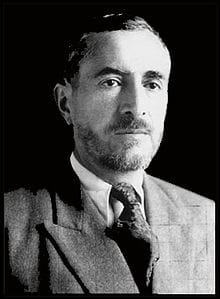
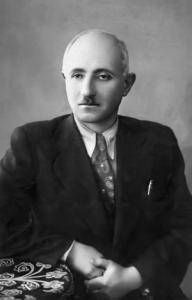
Kurdish and Azeri Presidents: Qazi Muhammad and Seyit Cafer Pişevari
Unfortunately, the international and regional conjuncture was against both Republics. The Azerbaijan National Government (Azərbaycan Milli Hökuməti) collapsed in November 1946; the Mahabad Kurdish Republic (Komara Kurdistanê ya Mehabadê) in December 1946.
As can be seen in the text of the agreement, Azeris and Kurds supported each other and fought together in difficult times. This solidarity strengthened mutual respect and understanding.
MIHÊ KAZAK
Again, I will not go too far: A significant part of the Geloylu Tribe, to which I belong, is Azeri. This statement may seem meaningless to many of my readers, but it has found its place in daily life as a tangible reality.
Mihê Kazak, the legendary leader of the Geloylu Tribe, had a son named Şeyhali who married an Azeri girl in the Karakoyunlu district. Their descendants multiplied within the Azeri language and culture but never forgot their affiliation with the Geloylu Tribe. The late Mikail Göleli, a symbolic figure for Turkish nationalists, was born into such a family.
Likewise, in the village of Karakoyun, a large Azeri Geloylu family with the surname "Çelikten" resides. These examples can undoubtedly be multiplied. I would like to remind you here that in my speeches before the Geloylu community, I drew attention to this reality by addressing my people with the words, "The Geloylu Tribe is an eagle. One wing is Kurdish, and the other is Azeri."
WHO IS QONAQ?
The Azeri word "Qonaq" means "guest." When this innocent word is adapted into political literature, it contains a frightening and provocative message. When it is said, referring to a people, "They are qonaq," this expression takes on a racist discourse, meaning the complete exclusion and denial of that people.
As far as I followed from the press, I read that our Iğdır Deputy said, "They are qonaq" for Kurds in one of his speeches. The political translation of this statement is as follows: "Iğdır is an Azeri (or Azerbaijan) homeland. Kurds are guests in these lands."
It is, of course, a great misfortune to use this expression for Kurds, who constitute 70% of Iğdır's population. Furthermore, this statement also makes an implicit reference to the indivisible integrity of Turkey.
However, I do not want to believe that our esteemed Deputy used this expression in a way that would imply this meaning. The fact that such an expression, which would pit two intertwined peoples against each other, is circulating these days is also frightening and disturbing.
Iğdır is the common homeland of all ethnic groups living there. It is the common homeland not only of Azeris, Terekemes, and Kurds but also of the Bulgarian Turks, known as "Göçmenler" (immigrants) among the people, who came from Bulgaria and settled in Iğdır in 1937, and the Ahiska Turks who settled in Iğdır since 1993.
Iğdır must be a city of peace and tranquility. It is easy to fragment Iğdır and drag it into civil war; what is truly difficult is to strengthen trust between peoples and exalt the spirit of peace. The true children of Iğdır must show this dedication. This historical responsibility rests on all our shoulders.
I would like to conclude my article with the seventh article of the agreement signed between the Azerbaijan and Kurdish Republics on May 3, 1945:
"Anyone who attempts to disrupt the relations of friendship and cooperation established between the two peoples throughout history, or who infringes upon their national unity, shall be punished by both peoples."