The Ayrım Clan and Misty Eyes
This essay recounts the life story of Selçuk Ayrım, from his childhood in Iğdır and his family's history to his taxi driving days, a poignant youthful love, and his later life, including encounters with famous figures and his family in Azerbaijan.
Dear Readers,
It was an evening. My phone rang. A childhood friend wanted to talk to me. We fell into conversation. We exchanged words full of mutual longing and affection. My childhood friend, as if he had suddenly found the true friend he was looking for, began to tell me his life story at length. He spoke of the dusty roads of Iğdır, our classmates, the Aras Cinema, his days as a taxi driver, and most importantly, the Misty Eyes that enveloped his heart and soul. It is up to me and to you to listen to what he said. With respect, Mücahit Özden Hun
MY FRIEND SPEAKS
My dear brother, you know our childhood was spent in the same place. I remember very well, I was driving a taxi while you were working in your pastry shop. We were both hardworking, respectful children. Moreover, we were classmates at Iğdır Middle School. We often stopped by the pastry shop, ate a sweet, and chatted. How beautiful those friendships were in those years, weren't they?
Oh, my readers don't know me? If you wish, let me first lay out my lineage before them. You know, in Iğdır, people know each other by their tribe, clan, and lineage. I also have a clan: the Ayrım Clan.
The Ayrım Clan is branched, strong, and powerful. The district-village named Gaziler, connected to Tuzluca, is the center of the Ayrım Clan. The old name of Gaziler was "Pernavut." This name is still frequently used among the people.
I belong to a family that has been known and respected as "Bey" in the region for years. If you wish, let me introduce you to the grand genealogy of my clan and my family tree:

Genealogy of the Ayrım Clan

Selçuk Ayrım's Grand Family Tree

Selçuk Ayrım's Family Tree
MY GRANDFATHER: CİMŞİT AYRIM

Cimşit Ayrım Bey (Far left, 1940)
My grandfather, Cimşit Bey, operated an inn near Gaziler on the road from Iğdır to Kağızman. The inn was known among the people as "Cimşit Bey's Inn."
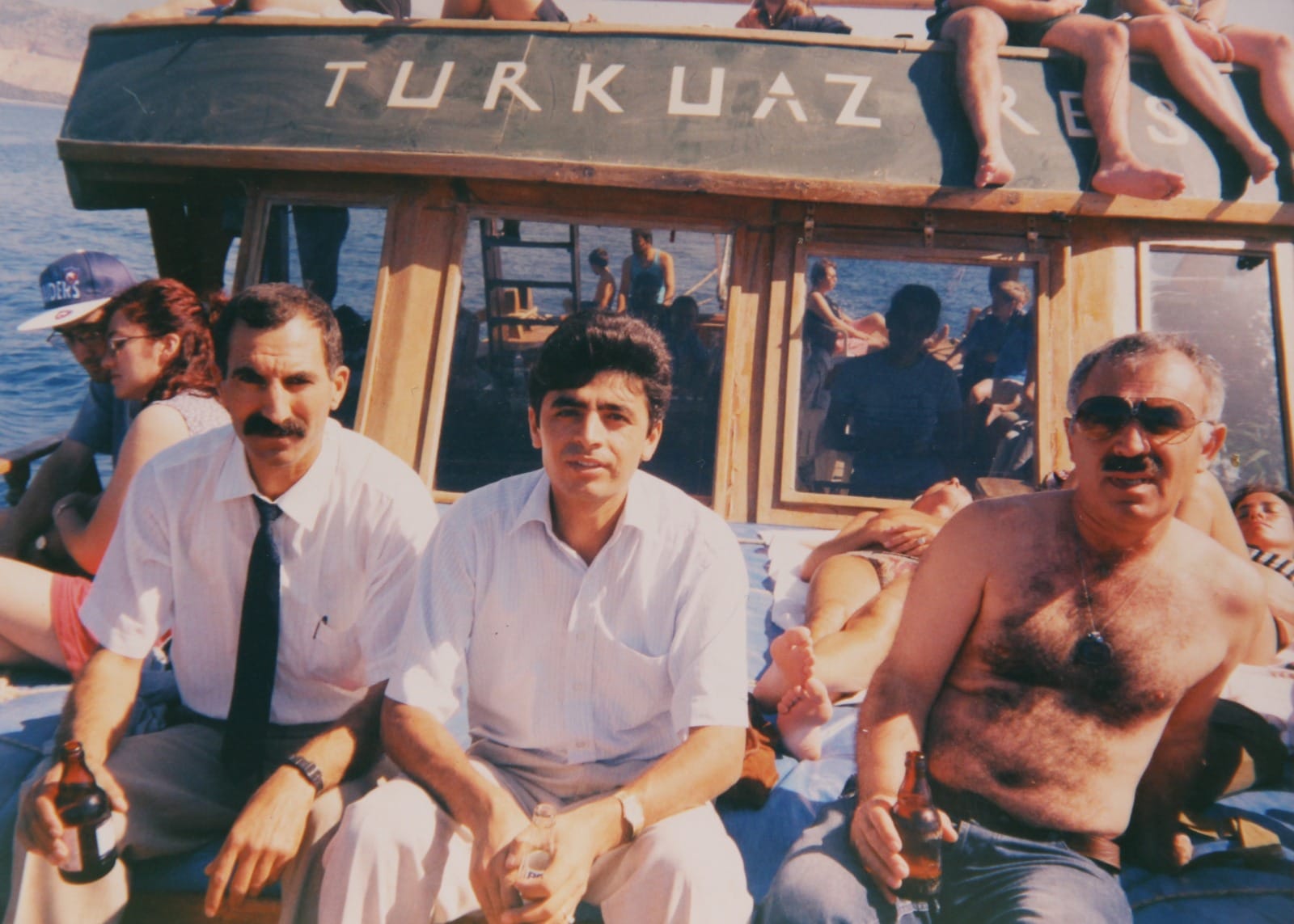
Cimşit Bey's Inn (Gaziler, 1954) Cimşit Ayrım Bey second from left in the middle

Cimşit Ayrım Bey and his grandchildren (Gaziler village, Cimşit Bey's Inn)

Cimşit Ayrım Bey and his wife Zeynep Hanım
The road from Iğdır to Kars and Erzurum passed in front of the Inn. It was a lodging center. In later years, the NATO road was built. The Inn had to be demolished. The state expropriated the land of the Inn. In my childhood, my mother would press my father, "Go, get your share!" My father, just to avoid this argument, would eat his meal and immediately go outside.
Cimşit Bey was open-handed and generous. The poor from the surrounding Kurdish and Azerbaijani villages would flock to the Inn, asking Cimşit Bey for money. Because of his helpfulness and generosity, Cimşit Bey was loved and respected in a wide area.
Additionally, there was a military battalion in Gaziler. Cimşit Bey, through a tender process, undertook the postal services for both the village and the military unit. A PTT building operated within Gaziler. The location belonged to us. Probably the state rented this building. In those years, since there were no motor vehicles, postal deliveries were made on horseback. I remember doing postal work on horseback as a child.
MY MATERNAL FAMILY ELDERS

My maternal grandmother's father İsmail İsmayilov

Three Siblings
(From left to right) Züleyha Ayrım, Yakup Yanar and Solmaz Hanım 1940

Selçuk Ayrım's mother Züleyha Yanar (1939)
MY FATHER FERİDUN (FERİT) AYRIM

Feridun (Ferit) Ayrım
My father served in the military during the Korean War years, but a ceasefire was signed between the parties just as his unit was preparing to be sent to Korea. The famous industrialist and businessman Saffet Ulusoy was my father's military comrade.

(Standing far right) Feridun (Ferit) Ayrım Pernavut, 1950s

Aydın Ayrım and Feridun (Ferit) Ayrım
The Ulusoy company was in international transport. Their vehicles going to and from Iran would pass in front of my grandfather Cimşit's Inn. In those years, there were no gas stations. Trucks and cars were filled with gasoline/diesel from cans. For this reason, there was a closeness between my family and the Ulusoy family. Saffet Ulusoy was our guest in Gaziler many times, and the friendly relations between the two families thus grew stronger.

From left to right Feridun Ayrım, Vahit Çağatay, Zahit Çağatay
In 1953, the State Production Farm (DÜÇ) was established in Iğdır, and my uncle Ziya Ayrım was appointed as its head. My father started working as a driver at DÜÇ and continued this duty until 1955. In those years, my mother's father, Kerim Ağa (Kerim Yanar), was working at the Agricultural Sales Cooperative. He was originally from Yerevan. Before coming to Iğdır, he was a contractor in Yerevan. Kerim Ağa and my grandfather Cimşit were very good friends. My father fell in love with Kerim Ağa's daughter, Züleyha Hanım.

Family Photo (1963)
Standing from left to right Feridun Ayrım, Ayla in his arms, his mother-in-law Hurşut Hanım, his wife Züleyha Hanım (Children from left to right) Öztürk, Handan, Gamze (with toy in hand), Selçuk

1960s… Seated from left to right Hürriyet Sansar, Hasan Sansar, Feridun (Ferit) Ayrım (Iğdır State Hospital staff Kars Yeşilyurt Restaurant)

Iğdır. Seated second from left: Feridun Ayrım
My maternal grandmother, Hurşut Hanım, was the daughter of İsmail Bey from Ganja. Kerim Ağa got engaged to Hurşut Hanım in Ganja. These were the years of the Republic of Armenia (1918-1920). One day, Kerim Ağa took his fiancée to a wedding in Yerevan. An argument broke out with Armenians. Kerim Ağa killed three Armenians in the incident. Hurşut Hanım's father, İsmail Bey (İsmail İsmailov), was a wealthy man. With half a can of gold, they all crossed the Aras River and came to Iğdır. According to their accounts, they also bribed Armenian soldiers while crossing the border.
These were the years when Iğdır State Hospital was established (1964). My father started working as a driver at the State Hospital. One day, when Dr. Kemal Karasu was the chief physician, an argument, then a fight, broke out between my father and Chief Physician Kemal Karasu, and my father broke Kemal Karasu's nose. Due to this incident, my father was suspended (1966).
My uncle Ziya Ayrım is a Senator. My father went to Ankara to my uncle Ziya Ayrım. In those years, the Kiti Hydroelectric Power Plant had just started operating (1966). He was appointed there as a driver. This time, the Kiti Manager (from Doğubayazıt) and Süleyman Bağcı complained about my father.
The incident unfolded as follows: The Kiti Power Plant assigned my father an open-back pickup truck. My father, on his way to Iğdır in the mornings, would pick up students from villages like Küllük and Yaycı who wanted to go to middle school and the newly opened high school, without charging them, and bring them to the city center. The Kiti management was disturbed by this situation and filed a complaint with the Ministry. An inspector came. He interrogated my father. My father defended himself:
"These young people will study and serve the country as doctors, engineers, and lawyers tomorrow. Why should it be a crime to help them?"
"This does not concern you! You will not use state vehicles for other purposes."
A heated argument ensued between the inspector and my father. Coincidentally, my uncle Senator Ziya Ayrım was also in Iğdır. My father went to my uncle Ziya, explained the situation. My uncle Ziya called the inspector and spoke sharply: "Is Ferit Bey doing something wrong? He supports students without taking any money."
My uncle Ziya told my father to calm down and that he would help him find a new job when he returned to Ankara. That year, the Tuberculosis Dispensary opened in Iğdır, and my father was appointed as a driver.
My father worked as a driver at the Dispensary until April 1977. He retired.
My father moved to Istanbul in 1984. My father smoked heavily. He had lung problems. He passed away in Istanbul on June 8, 2006, at the age of 78. May God have mercy on him!

Ferit Ayrım and his wife Züleyha Hanım
MY UNCLE FERMAN AYRIM
My uncle Ferman Ayrım was the official driver for the Governor of Bilecik. He tragically passed away on June 30, 1969. I was an 11-year-old child. The mourning within the family is still vivid in my memory today. May God have mercy on my uncle Ferman!

Ferman Ayrım (Right) with the official car of the Bilecik Governorship (1965)
YENİ GAZETE

(June 30, 1969) Bilecik Governor, Retired General Muammer Ürgen, plunged into the Sakarya River the previous night with his official car, license plate 11 AA 001, and drowned along with his driver Ferman Ayrım.
During the accident, which occurred in the Cambazkaya area 40 kilometers from Bilecik, according to the initial investigation, it was understood that Governor Ürgen was at the wheel. The first to witness the accident were villagers. According to the on-site investigation, in the accident, which likely occurred around midnight on the return from İzmit, the Governor's official car veered off the right side of the road, skidded about 30 meters to the left, then overturned at the edge of a 10-meter high cliff and rolled down.
The villagers stated that the Governor's car was completely overturned in the water, and only half of its wheels were visible. The villagers who made the initial intervention pulled the car to the side with ropes and saw that the Governor was at the wheel and his driver was in the back seat.
The bodies of the Governor and his driver, retrieved from the water, were brought to Bilecik in the afternoon.
Ürgen Pasha, married with 4 children, was appointed Governor of Hatay on May 37, then transferred to Aydın, and from there to Bilecik.
MY CHILDHOOD

Selçuk Ayrım at 1 year old (1958)

Iğdır Cumhuriyet Primary School (1967) Selçuk Ayrım (Left hand in the air, with a pistol in his sash) (Who knows, he might be shouting "Vatan Yahut Silistre" - Homeland or Silistre.)

Selçuk Ayrım (Iğdır, 1969)

Iğdır High School (Middle School Section) Selçuk Ayrım (seated, 1970)
"MISTY EYES"
How happy I am, if only you knew! Finally, I found a friend with whom I could share the traces of a love that had settled like lead deep in my heart.
It must have been 1968. I was a fifth-grade student at Iğdır Cumhuriyet Primary School. During breaks, we would run to the vendors in front of the school and spend whatever we had in our pockets. The "ballı" (honeyed) ring dessert was the most popular.
It was one such day. I was queuing in front of the street vendor's glass counter. I met her gaze. She was also in line, but the school bell would ring before it was her turn. She must have known this, so she approached me, extended her money:
"It will be a bother for you! Could you get one for me too?"
I had enough money. I bought two ring desserts, and handed one to her. We quickly devoured them before the school bell rang. When the bell rang, we rushed to different classrooms.
In the following days, we would meet either in the school corridor or in the garden. Of course, we were both children. But I understood one thing: the greatest loves always begin at this age.
It was the wedding of the late Nihat Işık. You know, Azerbaijani weddings are magnificent. The greatest loves are born at weddings. When the sound of the accordion filled the wedding venue, hearts yearned for love. That day, I was also in such a mood. She had also come to the wedding. Yes, yes! This wedding, unknowingly, cemented my love. Everything happened suddenly! A deep and meaningful glance was enough for everything! It was as if I had become her slave. In the following days and months, I would always seek her deep and melancholic gaze.
I was a cinema enthusiast. We had Serhat and Aras cinemas in Iğdır. I never missed a single movie.

Starring: Cüneyt Arkın, Nilüfer Aydan (Canım Sana Feda, 1965)
(In Iğdır of yesteryear, before a new film was released, its poster would be pasted on a wooden board, and people would gather in phaetons or daşkaya (horse-drawn carriages), driving through neighborhoods while shouting, "Coming soon, Cüneyt Arkın, Nilüfer Aydan. Don't miss this film: Canım Sana Feda")

In front of Iğdır Aras Cinema (1965) (Selçuk Ayrım, seated in front)
I was 13 years old (1970). One day, I saw a movie poster in front of the Aras Cinema. It felt as if my heart would stop. Yes, her eyes were on the movie poster. The film, starring Türkan Şoray and Murat Soydan, was titled "Misty Eyes." How much Türkan Şoray's gaze reminded me of her eyes.

From that day on, I had secretly named her "My Misty-Eyed One" within myself, the one who had taken over my heart and was the master of my thoughts. I carried Misty Eyes with me everywhere, I slept with her, I woke up with her. Misty Eyes was a secret in my heart. It was impossible for me to talk about her to anyone. It was as if she was my reason for being. It was as if I lived for her. My only happiness in life was to think of her, to carry within me the hope of seeing her again.
Has the night's dew fallen on your eyes?
Please, don't look at me so wetly.
Let your hair fall on my chest, tell me your sorrow.
Just don't look at me so wetly.
MY TAXI DRIVING

1960s. Entrance to İdirmava. Old Police Station. The front serves as a coffeehouse. (Property owner Fahrettin Aras)
Driving was, in a sense, my father's profession. Even as a child, I wanted to drive a car, to be a driver, just like my father.
One day, my father went to Özer Zülaloğlu's corner shop. He ate some pastırma offered to him. For some reason, this pastırma caused an intestinal blockage in my father. We urgently needed to take my father to Erzurum.
In those years, there were two taxis in Iğdır: a Chevrolet belonging to Yusuf Toktamışoğlu and a Ford belonging to Yakup Öcal. Yusuf Toktamışoğlu took us to Erzurum and brought us back. Gasoline was 155 kuruş per liter. We paid 500 TL for this trip. My father's civil servant salary was 680 TL. We had spent almost a month's salary of my father on travel expenses.
It was clear that there was money in the taxi business. I had just finished the first grade of middle school (1971). My mother was raising 38 cows and buffaloes. The cream and cheese she made with great effort did not bring much income. I did a calculation: Phaetons went to the neighborhood for 5 TL. It was possible to charge a customer 10 TL by car.
Rıza Ambarcı had a grocery store. When my father received his salary, he would first stop by Rıza Ambarcı's and settle his debt on the ledger. In those days, when meat was 2.5 TL per kilo, my father's salary would melt away. Since the family was large, my father was starting to struggle with payments.
I confronted my mother:
"If our car makes 10 trips a day, we earn 100 TL a day, and 3000 TL a month. If 500 TL goes to expenses like gasoline, we'll have a profit of 2500 TL. My father's salary is 680 TL. Let's buy a car!"
I convinced my mother to buy a car. My father was reluctant. My mother nagged my father for days, in a sense, "eating his head" about it. My father gave in. In those years, Renault (Reno) cars had just entered the market for the first time. Their price was around 57,000 TL. We sold the animals, but we were short 10,000 TL.
My father took me with him, and we went to the house of our kirve (a traditional bond of kinship), Hacı Musa Baktemen. Our kirve lived in Alikamer village.
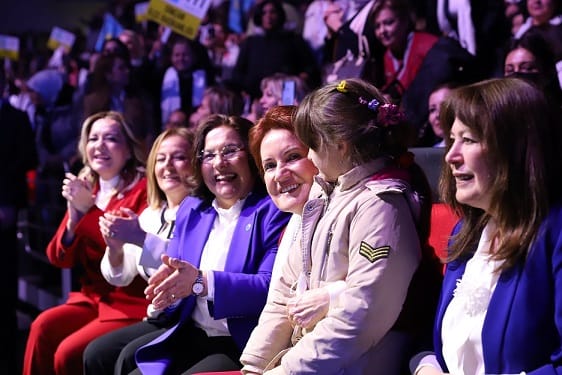
Selçuk Ayrım's kirve Musa Baktemen
(Musa Baktemen, loyal to the spirit of kirvelik, generously hands Selçuk the missing money, perhaps changing the young man's entire life.)
Meanwhile, I can't help but squeeze in a memory. My circumcision ceremony was held at the Military Casino. While the ceremony was ongoing, news arrived of the death of former President Cemal Gürsel (September 14, 1966). Upon warning, the ceremony was cut short.
My father, with a somewhat embarrassed expression, explained why we had come. Our kirve was open-handed and generous:
"No problem! Let's meet in front of Vakıflar Bank tomorrow!"
The next day, we met in front of Vakıflar Bank. Our kirve didn't want my father to come inside the bank. We went into the bank together. He withdrew 10,000 TL. He wrapped it in newspaper and handed it to me, admonishing: "There's no hurry to pay this money back to me. You'll pay it back when you earn money."
Actually, it was clear that my kirve was giving me this money as a gift, in a sense, to help me start a business, but I was determined to pay back this debt no matter what.
Our kirve said goodbye and left. My father and I, fearing we might lose this amount of money, decided to deposit it in the bank instead of carrying it with us. This time, my father and I went into the bank together.
Now it was time to buy the car. My father went to Ankara, to his brother. Normally, there was a waiting list for cars. Since deputies and senators were given priority, my uncle Senator Ziya Ayrım intervened. My father went to Bursa and picked up the car. When he arrived in Ankara, he called to inform us of the situation.
In those years, very few people had telephones at home. For such conversations, one had to go to the PTT. My father said he would set off with the car and would call us again when he reached Erzurum. A few days later, when he called from Erzurum, I told him I would be waiting for him at my uncle Cimşit's Inn on the Iğdır-Tuzluca road.
My father had a special horn installed on the car. When he entered Iğdır, my father proudly honked the horn. Everyone's eyes were on us. My father parked the car in front of the Municipality Building. The cream-colored car was sparkling and dazzling. Now, three taxis would serve Iğdır.
I was 14 years old. I didn't know how to drive. My father hired a driver from Erzurum. I would sit in the front seat of the car, and we would carry passengers with the driver. I carefully watched every move of the driver, trying to learn the profession. At the same time, I was noting down how many passengers we took in a small notebook.
It was the end of the month. The driver from Erzurum and my father were going to sit down and settle accounts. The driver put the money on the table. This was much less money than I expected. According to my notebook, the amount should have been much higher. I was uncomfortable with this situation. The driver took my outburst as a matter of pride, threw the keys on the table, and left. My father was angry. He slapped me and added: "Because of you, we lost the only driver we had."
Our car remained abandoned in the garden. I was seething inside, unable to stay still. I, too, had made it a matter of pride and was looking for a solution of my own.
There was an irrigation ditch in front of our house. The wooden bridge over it was not very wide. To get the car out of the garden onto the street, I had to get it over this bridge without incident.
No one was home. I took the key and started the car. I was short. I put two large pillows under me. At first, I didn't dare to drive the car over the wooden bridge. I got out. I measured the width of the bridge with my feet. I measured the distance between the car's two wheels in the same way. The bridge was, just barely, a little wider. I gathered all my courage and got into the car. Slowly, I drove the car over the bridge. Without changing gears, staying in first gear, I grumbled the car all the way to the Municipality Garden. I didn't dare to change gears. In those years, since there was no traffic, I could drive the car at a slow pace.
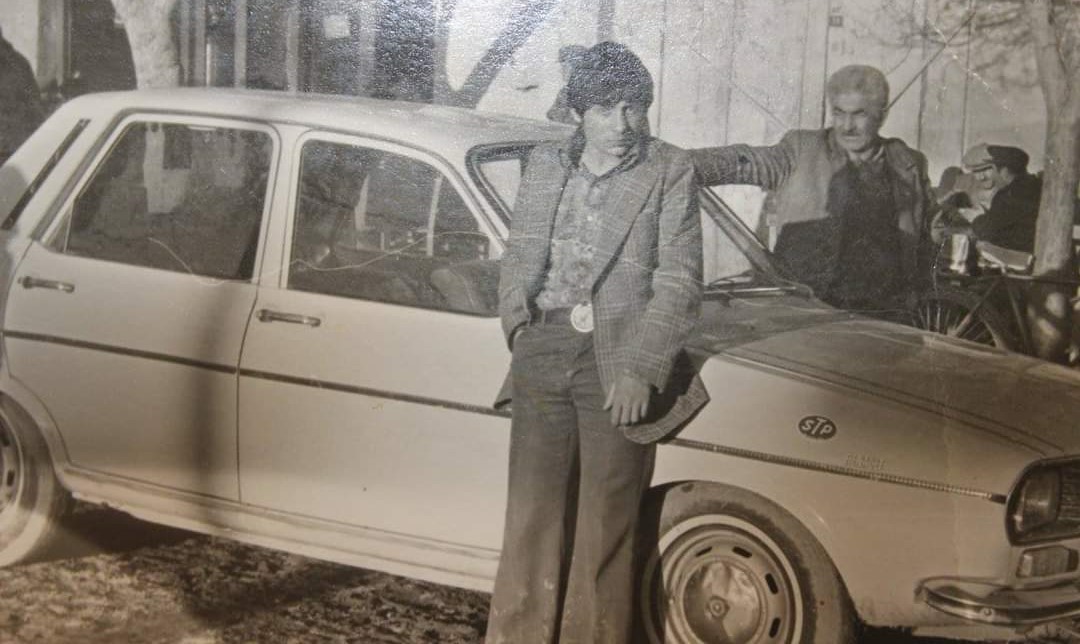
Selçuk Ayrım (front) and his father Ferit Ayrım (Iğdır, 1973)
I parked the car. I took a breath. Just then, Uncle Yusuf, nicknamed "Sarı Yusuf," who traded animals, came up to me:
"Can you take us to Evci village?"
"Of course!"
"How much?"
"40 TL!"
We agreed. We set off. I left Şehit Mehmet Çavuş street behind in first gear. At that moment, for no reason at all, Misty Eyes filled my being. I was driving and thinking of Misty Eyes. My fear disappeared. I slowly shifted into second gear. A strange feeling arose within me: as if someone would tell Misty Eyes about my courage, and she would love me even more. I drove towards Evci village without changing gears.
While I was sitting behind the wheel with great excitement, the customers inside were engrossed in a heated bargaining, speaking Kurdish... They were unaware of my timidity and inexperience.
In those years, there was a large canal surrounding Iğdır. It passed near Evci village. There was a wooden bridge over the canal. As I approached the bridge, fear seized me again: "Is the bridge wide enough?"
While the car was running, I put it in neutral and pulled the handbrake. I got out of the car and started pacing the width of the bridge. Seeing this, Uncle Yusuf rushed out in a panic: "You're going to tip us into the canal and kill us all! Cross the bridge, we'll get in your car afterwards."
I got behind the wheel. I felt as if Misty Eyes was looking at me. I gathered my courage and slowly drove the car safely over the bridge. The customers got back in the car. We set off. After Evci, we stopped at Alut (Yüzbaşılar) village and returned to Iğdır. Uncle Yusuf handed me 40 TL, and couldn't help but add: "God bless you! If it were Toktamışoğlu, he would have charged us 120 TL."
After I took the car and left home, my mother came home. She saw that neither the key, nor the car, nor I were there. She panicked. She informed my father. They started looking for me everywhere. Finally, when they found me and the car in the area in front of the Municipality Building, my father breathed a sigh of relief.

Selçuk Ayrım and Cengiz Bilen (Behind, Iğdır 1976)

İdirmava Road. The irrigation ditch crossing the city from one end to the other, with ducks swimming in it, and Selçuk Ayrım's taxi

Iğdır High School Teachers (1970s)

Iğdır Youth in the 1970s
JUDGE HANUM
From that day on, I quickly gained mastery.
I was 14 years old. I didn't have a driver's license. There weren't many traffic police, but there was still a risk of getting caught.
In those years, a young lady was appointed as a judge in Iğdır. One day, while sitting on the balcony of the Government House drinking tea, she saw a car pass by without a driver. She called the officials and asked whose car it was. There were three taxis in the district. Everyone knew the cream-colored Renault car belonged to us.
An official came to me and said that the judge wanted to see me. I presented myself. The judge could not hide her surprise when she saw me. There was a small child in front of her. She asked curiously:
"Are you driving this car?"
"Yes!"
"Then you will teach me how to drive."
I gladly accepted this request. I would take the judge in the car and drive her to Mecit Hun's large lands near Karakuyu village.
A month later, she had gained as much skill as a professional driver. Thanks to this friendship, the traffic police stayed away from me. Whenever the judge had a field inspection or something similar, she would set off in my taxi. She was generous and would give me more than I deserved.
The judge stayed in Iğdır for 3 years. I continued driving without needing a license.
MY YOUTH DAYS IN IĞDIR

Friends' Gathering Selçuk Ayrım (Far right) 1974

Selçuk Ayrım (Iğdır, 1974)

Selçuk Ayrım (Kemal the Coffeehouse Owner's coffeehouse, 1974)

Iğdır Youth
Selçuk Ayrım (Second from right, 1975)

Iğdır Youth Selçuk Ayrım (Third from left)

Iğdır High School Years Selçuk Ayrım (far left)

Selçuk Ayrım
WITH MECİT HUN ON THE ROAD TO KARS
Iğdır was a district of Kars. People from Iğdır had to go to Kars for important bureaucratic matters.
It was another winter day. The Kars road was closed for days due to heavy snowfall. Mecit Hun came to me, complaining helplessly: "I absolutely have to go to Kars, otherwise my specifications will expire. Can you go to Kars in this snow?"
"Uncle Mecit, let's take a can full of dried dung and rubbing alcohol with us. We'll need it to keep warm. If you ask the battalion, they have chains. Let them lend us one."
We took the chain and set off. The Kars road in those years followed a different route. Intertwined bends stretched out terrifyingly. Showing my driving skills, we fearlessly battled the snow and continued our journey.
After leaving Kağızman and turning onto the Kars road, a sudden ascent began. On the right side of this road was Paslı Han (Cilaxana). Most of the time, respected individuals would not want to stop at this Inn unless absolutely necessary, as it employed women. We passed by it quickly.
The snow continued to fall. There was no one on the road, nor any other car. I wasn't afraid because Misty Eyes was with me. Thinking of Misty Eyes, with a secret joy within me, we bravely traversed the silent and snow-white roads, winding our way up the bends. My attention was on the road, but my soul and being were filled with Misty Eyes. How could a child carry such a great love in his heart tirelessly?
We arrived in Kars. Mecit Hun intervened in time, preventing the cancellation of the specifications he cared about. It was getting dark. Mecit Hun wanted to return to Iğdır immediately. I didn't think this was right: "The snow continues to fall. The roads are closed. If we get stuck in the snow, we'll be food for wolves. Let's spend the night in Kars."
That's what we did. We checked into a hotel. I'll never forget, there was a Turkish bath under the hotel. When I lay down on the hot stone, it felt as if all my fatigue had gone. My thoughts drifted to Misty Eyes. She was calling me to Iğdır.
"LEGEND OF MOUNT ARARAT" FILM

The year is 1974. The famous director Memduh Ün had come to Doğubayazıt for the filming of "The Legend of Mount Ararat." His long-time girlfriend, Fatma Girik, was the lead actress. Memduh Ün had arrived in his American Buick car, but the car couldn't handle the slopes and overheated. He couldn't find a reliable taxi in Doğubayazıt. He came to Iğdır. In this search, he stopped by the Iğdır Tourism Bus agency. He asked Hacı İbrahim Bayat, the person in charge, for help. Hacı İbrahim didn't hesitate:
"The only name I can trust is Selçuk Ayrım. He is a skillful young man who knows his job."
They called me. They were sitting in Kemal's coffeehouse, drinking tea. In later days, Memduh Ün would laughingly recount the tea-drinking ceremony: "The tea comes, but there's no spoon. I ask for a spoon, and they look at me strangely. Then I understood that people in Iğdır drink tea 'kıtlama' (with a sugar cube)."
Memduh Ün began:
"The filming will last approximately 40 days. During this time, we need a taxi that will not leave our side. We will be driving around on mountain roads. Would you accept such a task?"
I was experienced in this matter. I was fearless. I used to take passengers to mountain villages like Mezraa, which had no roads. My self-confidence was high. However, I needed my father's approval. I asked for permission and went to my father, who was working at the State Hospital. I explained the situation. My father's first question was, "How much will they pay?"
"Father, I haven't negotiated that. They will pay me what I deserve one way or another."
I returned. When I said I accepted the offer, Memduh Ün interjected:
"How much will it cost?"
"Whatever you give is acceptable to me. I will not object. Just pay for the gasoline."
No matter how much he insisted, I didn't negotiate.
Filming began. I was driving the film crew to and from the mountains. Every morning, I would also tie Fatma Girik's sash.

Fatma Girik and Selçuk Ayrım (Doğubayazıt, 1974)
One day, Memduh Ün couldn't hide his jealousy:
"Fato, I'm starting to get jealous of this kid. Why do you let him tie your sash every morning?"
Then the filming was completed. Memduh Ün handed me a sealed yellow envelope.
"Your payment is inside."
Memduh Ün had been generous. He had put much more money in the envelope than I expected. I also had some money in the bank. I combined the two and went to Kars to buy a new car from Resul Yıldız.
MY DRIVING TEST
When I turned 18, I went to Kars to get my driver's license. First, there was a written exam. I got a high score. Then it was time for the driving test. It was winter. The police officer sat next to me and commanded, "Drive!" We came to a hilly area. Everything was icy. The police officer commanded, "Stop the car!" but I didn't listen to him, I continued to drive until I got up the hill. The police officer snapped at me:
"I tell you to stop, and you keep driving. You won't get a license! Tell me, why didn't you stop?"
"If I stop on such a hill, it won't be possible to get the car moving again!"
The police officer smiled: "Well done, that's what I wanted to hear. Come in the afternoon, your license will be ready!"
FAREWELL TO MISTY EYES

Kars Girls' Teacher Training School (1968)
Misty Eyes was studying at the Girls' Teacher Training School in Kars. The school was next to the Milk Factory. In the middle of winter, I would set off from Iğdır to Kars, see Misty Eyes, and return. My father couldn't understand my situation and would be surprised:
"There are two meters of snow on the roads! You'll freeze to death."
My father was wrong. Love blinds a person. It doesn't care about danger or anything.
It was during the days when Misty Eyes came to Iğdır. I asked: "If you marry me, I will do everything to make you happy. Do you accept?"
Misty Eyes remained hesitant. At that moment, everything was over for me. I quickly walked away.
I graduated from high school in the 1975-76 academic year. I had no desire to go to university. I felt alienated from life. I wanted to go to the military as soon as possible, to get away from Iğdır. My military service was deferred. I struggled, and I had my deferment lifted. My military service was assigned to Çanakkale as a gendarme. I stopped by Hüseyin Yeşilyurt's shop and bought a military suitcase. The bus was departing at 13:00.
When I entered the garden, my mother saw the suitcase in my hand. She understood I was leaving. She also knew that I could no longer bear the weight of Misty Eyes in my heart. My poor mother put on her çarşaf (veil) and set off for Misty Eyes' parental home. I hastily stuffed my belongings into the suitcase.
As the bus pulled away from the city, a feeling of separation filled my being. I was determined. I was now embarking on a path of no return. Of course, I couldn't have known then that my foot would not touch Iğdır again for 30 years.
As the bus drove on, the Azerbaijani melody I loved echoed in my mind:
I cannot sleep at night from my thoughts
I cannot cast these thoughts from my head
What can I do that I cannot reach you
Separation, separation, oh separation
Separation, worse than any other pain
I served as the Pasha's driver for 19 months.

Selçuk Ayrım (Pasha's driver in the military)

Selçuk Ayrım in the Military
116th Gendarmerie Regiment (Çanakkale)
They put me on a salary of 1700 TL. When I was discharged, I had saved a considerable amount of money. I invested in land in Istanbul. In later years, I sold this land for a profit.
After my military service, I started working at the Tekel General Directorate in Istanbul.
MY RELATIVES IN AZERBAIJAN

Selçuk Ayrım's relatives in Ganja
It was during the days when the Soviet Union was collapsing (1991). I was working in Istanbul. Somehow, I met a Russian girl. She had come to Turkey to buy textile products and had lost a large sum of money to someone. I involved my acquaintances and got her money back. When she returned to Moscow, she invited me. Her father was a Lieutenant Colonel. He had a wide network. I made a request:
"My mother's relatives live in Azerbaijan. Their surname is 'İsmayilov'. Can you find them?"
They retrieved a list of all my relatives from the Soviet (Russian) archives and gave it to me. They lived in cities like Baku, Ganja, and Şemkir.
Even during the Soviet Union, we were partially in contact with our relatives in Azerbaijan. In 1972, my maternal grandmother's (Hurşut Hanım) sister, Şöket Hanım, came to Iğdır.
The incident unfolded as follows: It was during the years when Heydar Aliyev was the Mayor of Ganja. Şöket Hanım visited him in his office. "My relatives (qoxum) live in Turkey. One of them (my uncle Ziya Ayrım) is a great man (meaning a Senator)."
A protocol was to be signed between Turkey and Soviet Azerbaijan. Heydar Aliyev came to Ankara. He asked his Turkish colleagues: "Is there a deputy with the surname Ayrım?"
In this way, he met my uncle Senator Ziya Ayrım. When Heydar Aliyev returned to Ganja, he prepared Şöket Hanım's documents and sent them to Moscow for approval.
Şöket Hanım came to Iğdır hoping to see her sister Hurşut Hanım, but unfortunately, Hurşut Hanım had passed away 1.5 months earlier. I cannot forget that day: When Şöket Hanım entered through the garden gate, she said with a sorrowful voice: "I know, my sister is dead!"
She collapsed under the mulberry tree and wept bitterly.
Şöket Hanım stayed in Turkey for two months. My father, along with my mother, took Şöket Hanım to İzmir, Ankara, and Istanbul for sightseeing.
One of my relatives (my mother's aunt's son) was the goalkeeper for the Soviet National Team. In 1988, his team had a match against Galatasaray in Istanbul.
Somehow, in the hotel where he was staying in Istanbul, he found my name in the city phone book. It was midnight. My phone rang. The Astor Hotel official explained:
"The Soviet goalkeeper is staying at our hotel. He says he's your relative. He wants to see you."
"Does he speak Turkish?"
"Yes! He says he's the grandson of Isa Bey (Kerim Ağa's father)."
Since it was during the Soviet Union era, footballers were not allowed to leave the hotel.
Coşkun Alagöz (son of Police Officer Rahim Alagöz) was the Deputy Police Chief of Fatih. It was midnight. I went to his house in Ataköy. He was surprised to see me at his door at that hour:
"What's wrong, Selçuk, what happened?"
I summarized the situation.
"Help me! I want to bring my relative home. I'll take him back to the hotel at 5-6 AM."
We went to the Astor Hotel together. I picked up my relative Halig Gafarov and brought him home.

Selçuk Ayrım's relative, Soviet National Team Goalkeeper Halig Gafarov (in yellow)
A NEW LIFE WITH AYNUR HANUM

Selçuk Ayrım and his wife Aynur Hanım
I met Aynur on the company's shuttle bus. Her grandfather had come from the Crimean Khanate in the late 18th century, settled in Düzce, and then in Istanbul. She was an intelligent and cultured girl.
One day we went to Kumkapı. There were coffeehouses with gardens and beautiful views. We drank tea. Aynur wanted to go to the Grand Bazaar. We walked together to the Grand Bazaar. Aynur entered a shop selling men's underwear. I was surprised. She bought two white undershirts and a nice shirt for me. When I asked her why she did this, she replied with a smile:
"You're wearing a white nylon shirt. And a red undershirt underneath. If you're going to walk around with me, you should pay attention to your clothes."
I was both embarrassed and happy that someone cared about me.
Aynur's words broke the spell that had trapped me since my childhood. I felt liberated. My soul was no longer anyone's slave.
One such day, when we went to Kumkapı again for tea, in a beautiful moment, I asked Aynur, "Will you marry me?"
We got married on October 4, 1983. Our son, Anıl, was born on September 10, 1984.
Thus, I had a new life. After retiring, we settled in Bodrum.
PORTRAITS FROM MY LIFE

Şamil Bey (Ayrım) (1880-1946)

Senator Ziya Ayrım, with Selçuk Ayrım in Bodrum

Selçuk Ayrım and Senator Ziya Ayrım, in Bodrum

President Abdullah Gül, Selçuk Ayrım and Deputy Şamil Ayrım

Deputy Şamil Ayrım and Selçuk Ayrım

Azerbaijani President Ilham Aliyev and Deputy Şamil Ayrım

Deputy Şamil Ayrım and Selçuk Ayrım

Deputy Şamil Ayrım and Heydar Aliyev

Deputy Şamil Ayrım and Selçuk Ayrım

From left to right Selçuk Ayrım, İlhan Aküzüm

Selçuk Ayrım, with his relatives in Azerbaijan

Aynur-Selçuk Ayrım's son Anıl Ayrım and Senator Ziya Ayrım (Bodrum)

Selçuk Ayrım and his wife Aynur Hanım

Selçuk Ayrım with his relatives living in Baku (Selçuk Ayrım second from right)

Aynur Hanım and Selçuk Ayrım

Anıl Ayrım

Selçuk Ayrım and his relative Asya Novruzlu from Azerbaijan

Our President Erdoğan and Asya Novruzlu

Selçuk Ayrım and his wife Aynur Hanım

Aynur Hanım and Selçuk Ayrım's two happy cats
The following two tabs change content below.