Kurdish Tribal Structure and the Intergenerational Sacred Trust Against Assimilation
This essay argues that Kurdish tribal structures, dengbêjs, and madrasas were crucial in preserving Kurdish identity, language, and history against assimilationist pressures.

Dear Readers,
The Kurdish people have endured some of the harshest oppressions in modern history. Their language was banned, they were prevented from educating their children in their mother tongue, their villages were emptied, and their names were changed. Normally, such a people would be expected to lose their identity quickly. But the Kurds did not disappear. This is because their greatest strength lay in their tribal structures and their memories. Today, many circles disparage tribes as “feudal, primitive, reactionary.” Yet, the truth is quite the opposite. Kurdish identity and language survived largely thanks to the tribes. For a tribe is not merely a chain of kinship; it is also a fortress of memory. I witnessed this truth once again a few weeks ago. While researching the role of Nado Agha (Nadir Taşdemir), a member of the Gelturan (Gelturî) tribe who lived in the Iğdır region, in the Civil War that took place in the Iğdır region in 1919-1920, I found that despite 105 years having passed and no written records existing, Nado Agha's life was preserved in memory with all its grandeur and in the finest detail. The struggle along the Karasu River line, the clashes in Taşburun, the evacuation of villages… A century passed, but the narrative remained unbroken. For Kurds, a narrative is not just an ordinary story; it is a sacred trust. The word passed down from grandfather to grandson is neither embellished nor altered. It is preserved as if it were a divine command. To distort a story is considered a betrayal of trust. This is why events that happened a century ago are still recounted today with the same words. As sociologists point out, memory is not individual but social. The community collectively determines what and how to remember. Among Kurds, this arrangement occurred within tribal structures, at mourning ceremonies, in village councils, and in the stran (songs) of dengbêjs. DENGBÊJS: HISTORY CARRIED BY VOICE Every tribal leader had a dengbêj. Dengbêjs were not merely artists who sang stran; they were the archive of society. Through their voices, heroism, defeats, joys, and sorrows were carried. If it were not for the protection of the tribes, dengbêjs, the cornerstones of Kurdish history, would not have had a chance to live, and historical information would have been lost in the silence of the past. An epic told by one dengbêj would travel from village to village, repeated by other dengbêjs. Thanks to this chain, it is not surprising that the same event is recounted in different regions with almost the same words. Dengbêjlik was a collective, not individual, memory mechanism. EVDALÊ ZEYNIKÊ: THE MEMORY OF SERHAD
Evdalê Zeynikê was born in the early 1800s in the village of Cemalverdi, in Tutak district of Ağrı. His father's name was Mustafa, his grandfather's name Hasan, his paternal great-grandfather's name Süleyman; his mother's name was Zeynê. He lost his father at the age of three and was raised by his mother. For this reason, he was known in his surroundings as "Evdalê Zeynikê," meaning "Evdal, son of Zeynê." According to the narrative, he is said to have lived for 113 years.
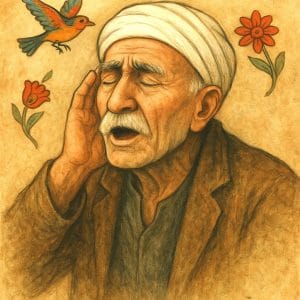
In his youth, he engaged in farming and shepherding. As he approached his thirties, he suffered a severe illness after a dream; during his recovery, the melodies he hummed in bed and the words he sang in a previously unheard makam (mode) attracted attention. This turning point made him one of the pioneers of Serhad dengbêjlik. It is not for nothing that Yaşar Kemal, in modern narratives, called him "the Homer of the Kurds"; for Evdal transformed the people, wars, exiles, and loves of his era into oral memory.
Evdal lost his sight in old age. In some narratives, the image of "blind eyes looking at a broken-winged crane" represents his mystical and melancholic inner world. His wife, Gulê, is also mentioned; in his poems, the burning intensity of love and satire coexist.
According to sources, Evdal, known as "Şahê Dengbêjan" (King of Dengbêjs), was also in the retinue of Sürmeli Mehmed Pasha, the Bey of Eleşkirt. During the Ottoman administration's attempts to suppress the Kozanoğulları rebellion, the Pasha took Evdal with him as he went to the region with hundreds of cavalrymen. This expedition was not merely a military movement; it was a difficult period marked by outbreaks of epidemics like cholera upon return, loss of life, and migrations and dispersions. According to the narrative, after the expedition, people from different lands dispersed to their homelands, and Evdal was among those who returned to Serhad alone.
This great upheaval inspired one of Evdal's most famous epics: "Wey Xozanê". The kilam (song) carries the wound opened by the Kozan expedition, the cries of those who took to the roads, and the sorrow of those left behind, through the power of words. Its continued vitality among the people even today shows how Evdal transformed language into a shared memory.
Evdal's voice carries the distinctive rhythm of the Serhad school. In his kilams, both lyricism and satire run together; they are sung with the same weight in various settings, from weddings to winter rooms, from long journey stops to pasha's divans. Short, direct, and striking expressions are prominent in his verses. Where he might mock a young girl's height, he immediately praises her; while describing the power of a beylic, he does not neglect the plight of a peasant. This fluctuating tone is the product of a genuine life experience.
Evdal performed not with a saz (lute) but with the pure human voice. This choice created a balance where the word carried the melody, and the melody re-established the word. Dengbêjs who listened to him followed the same style of expression in many regions, especially in Serhad. It is not for nothing that the phrase "Evdal's breath" has become established in today's dengbêj assemblies.
Sources state that Evdalê Zeynikê passed away in 1913. He left behind not only kilams but also a memory technique: the chain that connects experience to verse, verse to melody, and melody to social memory. His legacy continues to inspire today's dengbêjs; his voice, like caravans that once crossed borders, continues to travel from land to land.
ŞAKİRO (1936–1996) Şakiro, whose real name was Şakir Deniz, was born in 1936 in the village of Toprakkale (Kelê, Kela Elajgirê) in Eleşkirt, Ağrı. His origins lie in the Redkî (Redkan) tribe. His family migrated from the village of Qerka in Yerevan in the 1915s and settled in Ağrı. Therefore, Şakiro's ancestry extends to Yerevan and the Redkî tribe. He became one of the most powerful representatives of dengbêjlik in the 20th century. His voice echoed throughout Mesopotamia.
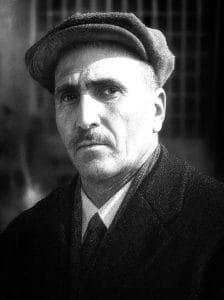
Şakiro Şakiro, in particular, preserved the memory of the tribes in Muş, Bulanık, and their surroundings in his stran. His stories contained not only love and heroism but also village evacuations, migrations, and oppressions. The tribes embraced him as the spokesperson for their own past. Şakiro's voice conveyed a vast memory, from village evacuations to migrations, from love epics to bitter losses, to the present day. His tribe preserved his memory, ensuring that dengbêjlik continued to live even in the modern era. The bond between Evdalê Zeynikê and Şakiro and the tribes shows that dengbêjlik was not an individual talent but lived on a social ground provided by tribal structures. Dengbêjs became the guardians of tribal memory and the strongest carriers of resistance against assimilation. MADRASAS: MEMORY SPACES LIVING UNDER THE PROTECTION OF TRIBES The history and literature of the Kurdish people were not completely erased despite official prohibitions and pressures. The biggest reason for this was the Kurdish madrasas under the protection of the tribes. Madrasas were not only institutions providing religious education; they were also cultural sanctuaries where the Kurdish language, literature, and history were preserved and carried into the future. With the law dated September 2, 1925, it was decided to close dervish lodges (tekke) and hospices (zaviye) throughout Turkey. This prohibition targeted not only religious orders but also Kurdish madrasas. This was because Kurdish madrasas had become institutions that kept the Kurdish language, literature, and history alive, in addition to religious education. The state's aim was to break religious and cultural independence by eliminating these structures. However, the tribes intervened. Even if madrasas were closed, the tribes provided a space for these institutions to live within themselves. Despite the prohibitions, madrasas continued their activities in villages, tribal councils, and secret rooms. Tribal leaders saw the madrasa not only as a religious institution but also as a point of resistance for the continuation of their identity. Therefore, they protected the teachers and students. Madrasas sometimes operated under the protection of a tribe, sometimes within the sphere of influence of a sheikh, and sometimes within the protected structures of mountain villages. Tribes provided food, shelter, and protection to madrasas. Teachers fleeing state oppression became guests of the tribes. Thus, Kurdish madrasas were able to survive despite the prohibitions. Tens of thousands of religious teachers who graduated from these madrasas served throughout the Kurdish geography during the 20th century. Each carried a "secret curriculum" outside the official education system:
- Ahmedê Xanî's Mem û Zîn,
- Melayê Cizîrî's divans,
- Feqiyê Teyran's poems,
- and many other works that were banned and removed from circulation among the people.
These works were taught to students like textbooks. Students were imbued not only with religious knowledge but also with Kurdish language, literature, and history. Years later, when they became teachers, they shared this memory with the people in sermons, conversations, funerals, and weddings. Thus, a banned literature, a banned history, continued to live among the people outside official institutions. These madrasas were considered "illegal," but the people voluntarily embraced them. In many villages, secret sections of houses, upper floors of barns, and even huts on mountaintops were converted into madrasas. Students herded sheep during the day and studied in the madrasa at night. In this way, Kurdish identity was not only preserved but also disseminated to wide masses.
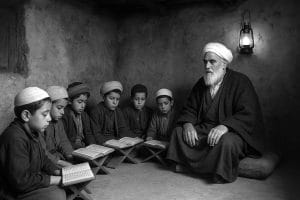
A secret madrasa room under tribal protection. Kurdish children memorizing Ahmedê Xanî's poems. Madrasas became a place of both religious and cultural resistance in the memory of Kurds. Even today, many from the older generation recount that they received madrasa education in their youth and learned the Kurdish language and literature there. If it were not for the tribes, Kurdish madrasas could have been completely destroyed after the 1925 prohibitions. If madrasas had been destroyed, the Kurdish language and literature could have faded away much earlier. But it did not happen. Because the tribes provided a living space for madrasas. And madrasas carried Kurdish history, language, and literature to the people. In a way, the tribes protected the madrasas; and the madrasas protected Kurdish identity. HISTORICAL REALITY: THE ROLE OF TRIBES The exiles, village evacuations, language bans, and forced name changes implemented from the early years of the Republic were aimed at eroding Kurdish identity. If it were not for the tribal structures, the Kurdish language and literature would have been erased long ago.
- Thanks to the tribes, dengbêjs were protected.
- Thanks to the tribes, madrasas survived.
- Thanks to the tribes, intergenerational narratives and genealogies were transmitted without distortion.
Therefore, tribes became the most fundamental cornerstone and the strongest refuge of Kurdish identity. Today, the stran sung at weddings, the conversations held at mourning ceremonies, and the stories recounted in village rooms still keep this memory alive. Dengbêj recordings shared on social media and young people sharing what they heard from their grandparents show that this chain has not been broken. The "sacred trust" now exists not only in village rooms but also in the digital world. CONCLUSION For Kurds, history is not in official books; it is preserved in memories, in the stran of dengbêjs, in madrasas, and in tribal councils. That is why they became a people who remember, not forget. Our duty today is not to belittle this memory but to embrace it. Because history writes about those who remember and protect the trust, not those who forget. It is true that the state banned their languages, closed their archives, and oppressed Kurdish society. But the Kurds knew how to keep their historical memories alive under the protection of tribes, dengbêjs, and madrasas.