The Legend of Mount Ararat: Parachute Ahmet
This article explores the life of "Parachute Ahmet," a unique legend of Mount Ararat, whose story embodies both mythical tales and remarkable fame, deeply intertwined with the history of Ishak Pasha Palace and the search for Noah's Ark.
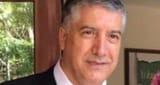
Dear Readers,
The word "legend" has two meanings:
The first is defined by the Turkish Language Association (TDK) as: "Imaginary stories, passed down from ancient times, that tell of extraordinary beings and events."
The second, strangely enough, is used more often in daily conversation but is not defined by the TDK: The second means "very famous in their time." For example, when we say "Metin Oktay Legend," we emphasize the second meaning. Thus, I am taking this opportunity to call upon the TDK.
"Parachute Ahmet" is a unique "Mount Ararat Legend" that encompasses both meanings.
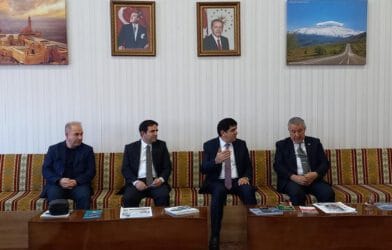
PARACHUTE AHMET'S FAMILY
The Geloylu (Gêloî) Tribe is spread over a wide area. During the time of the Ottoman Empire and Tsarist Russia, the Geloylu Tribe was dispersed between the borders of the two empires. In those years, there was a significant community of the Geloylu Tribe in the Beyazıd Sanjak, with a steadily increasing population.


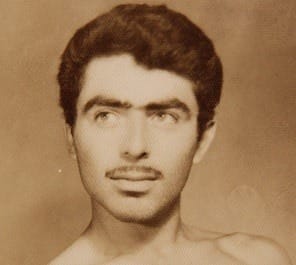
Parachute Ahmet's great-grandfather, Hoca Yusuf, served as a religious teacher in Erciş. His son, Numan Efendi, graduated from Erzurum High School, went to Istanbul, the capital of the Ottoman Empire, and graduated from the Faculty of Political Sciences. He returned to the Beyazıd Sanjak and served as Deputy Governor.
In later years, Numan Efendi served as Iğdır's first Provisional District Governor (November 1920), first Land Registry Director (1924), and first Attorney (1928). In the autumn of 1930, one midnight, while walking with a friend, he was shot in the heart from behind a wall and died on the spot. Unfortunately, the burial place of Numan Efendi, who held important positions in Iğdır's history, is unknown.


Parachute Ahmet's father Şefik Bey and mother Feride Hanım (in the back, his elder brother Mehmet Ertuğrul; the baby is Parachute Ahmet's son Numan)
ISHAK PASHA PALACE
I have visited many palaces around the world. There are two palaces that captivate my soul and leave me in awe every time I see them: the Alhambra Palace in Granada, located in the Andalusia region of Spain, and the Ishak Pasha Palace in Doğubayazıt.
Both evoke the motifs of 1001 Arabian Nights in my soul, inviting me to another world. Both are situated on rocky outcrops like eagle's nests. With their harmony with the natural environment and their decorations, both have more than earned their fame.
Ishak Pasha Palace was completed in 1784/85, but it was not fortunate. In 1840, a volcanic eruption occurred on Mount Ararat, followed by an earthquake. Ishak Pasha Palace suffered severe damage from the earthquake. It was abandoned for a long period of about 20 years. It was repaired. Just as it reopened for service, this time during the 1877-78 Ottoman-Russian War, the Russian army besieged Ishak Pasha Palace and subjected it to artillery fire. The palace, which had barely recovered from the earthquake's destruction, became a target for cannonballs and was reduced to a semi-ruin. Not much time passed before World War I broke out. The Russian army occupied Ishak Pasha Palace between 1914 and 1917. The palace was damaged once again.

When the Republic of Turkey was declared on October 29, 1923, Ishak Pasha Palace became both a civilian and military administrative center. Meanwhile, the name of the Beyazıd Sanjak was changed to "Doğubayazıt." The city, built at the foot of the castle, was moved to a flat area 5 km away from Ishak Pasha Palace. While new houses were being built, stones from the palace were stolen, and the palace was damaged once again.
Ishak Pasha Palace was finally taken under protection by a law enacted by the state in 1937. Abdurrahman Bey (Parachute Ahmet's grandfather) served as a guard in 1940. He continued this duty for 17 years until 1957.

(Far right) Parachute Ahmet's grandfather and the Ishak Pasha Palace guard at the time, Abdurrahman Ertuğrul, brother of Numan Efendi; (far left) Parachute Ahmet's uncle Yusuf Ziya Ertuğrul, the two people in the middle are inspectors from the Ministry of Culture (1956)
When Abdurrahman Bey passed away, his son Şefik Bey (Parachute Ahmet's father) took his place. Şefik Bey also remained in this position for 38 years until 1995. Until his death, he successfully continued both the security and record-keeping duties of the palace, as well as his role as a ticket officer.
Şefik Bey stayed inside the castle with his family during the summer months, and in the winter, he locked the castle gate and moved to his house in Doğubayazıt. This way, his children had the chance to attend primary school, albeit intermittently.
AND PARACHUTE AHMET IS BORN

Parachute Ahmet was born on April 16, 1971, in Ishak Pasha Palace. These were probably the days when Şefik Bey left Doğubayazıt and settled in Ishak Pasha Palace after a long winter.
Parachute Ahmet's childhood was spent in Ishak Pasha Palace. He accompanied tourists. His interest in foreign languages grew. He could speak almost every language brokenly. He was an enthusiastic and hardworking child. He never left the side of tourist groups. In their conversations and discussions, he would escape from his current reality and see himself as a global citizen. That day, he made his decision: Yes, one day he would travel the whole world and become a well-known name in archaeology.
At a young age, in 1982, he opened an information office for foreign tourists under the old Doğubayazıt Municipality Building. He took tourist groups to Mount Ararat and its surroundings, especially to Ishak Pasha Palace.
One day, an Italian tourist group arrived in Doğubayazıt. Ahmet's task was to take the tourist group up Mount Ararat. Ahmet was fast, agile, and hardworking. He was active. He rushed to everyone's aid. He did his best to make his guests comfortable. The Italians left Doğubayazıt pleased.
In the winter of 1982, one day, Ahmet received a letter from Italy. He opened the letter with curiosity. His friends and familiar taxi drivers also gathered around him with curiosity. The letter began with the sentence: "Dear Parachute."
His respected elder, Hacı Çeto Bey, interjected: "Indeed, a name truly befitting you!"
From that day on, Ahmet's nickname "Parachute Ahmet" was etched into memory. And thus, his global adventure as "Parachute Ahmet" began.
Parachute Ahmet knows Mount Ararat step by step. Ishak Pasha Palace is the home where he grew up. The scent of history and the allure of Mount Ararat have permeated his soul.
The majority of tourists visiting Mount Ararat are researching "Noah's Ark." This provides him with the opportunity to meet world-renowned astronauts, archaeologists, theologians, geologists, and scientists. Now, Parachute Ahmet is an indispensable name for all of them.
Parachute Ahmet, who established the Doğubayazıt Mountaineering and Tourism Development Cooperative in 2001, is also the founder of the Doğubayazıt Search and Rescue Association (2004). As the president of both associations, Parachute Ahmet continues his multifaceted activities in this direction.
Soon after, Parachute Ahmet received invitations from abroad. He participated in symposiums held in Hong Kong three times.
Due to public awareness, a replica of Noah's Ark, as described in the Holy Scriptures, was opened to the public as a museum in Hong Kong in 2012. The ship, 136 m long and 22 m wide, also exhibits 67 pairs of animal figures. The amusement park, built at the foot of Hong Kong's famous Tsing Ma suspension bridge, also features a restaurant and a hotel.


Hong Kong-based Noah's Ark Ministries International group on Mount Ararat (Parachute Ahmet seated far left)
Parachute Ahmet is invited to press conferences held in Europe regarding Mount Ararat and Noah's Ark, where he makes presentations. He also received the Collector's Certificate from the Ministry of Culture in 2022.
Parachute Ahmet opened "Noah's Ark Village" in Doğubayazıt. He also took over the management of the restaurant built by the Ministry of Culture directly opposite Ishak Pasha Palace and named it: "Parachute Cafe&Restaurant."
Noah's Ark Village, located 17 km outside Doğubayazıt with a view of Mount Ararat, includes two boutique hotels, 12 stone bungalow houses, and a 3-story restaurant.
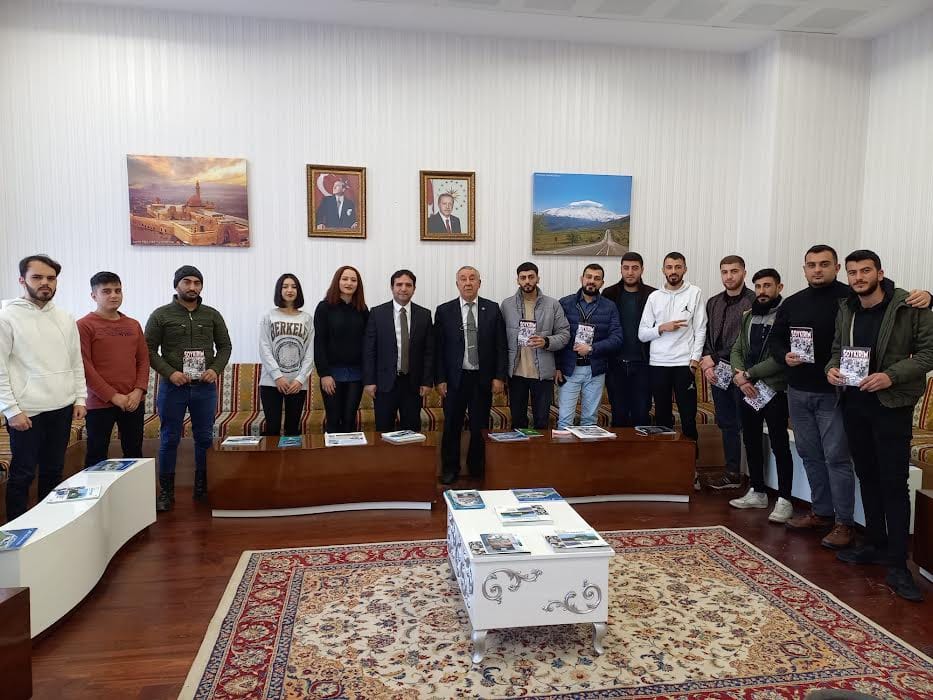
Parachute Ahmet's activities in recent years can be summarized as follows:
- Symposium in Beijing, the capital of China
- Symposium in Zeist, Netherlands
- 2 Symposiums in Charlotte, North Carolina, USA
- 2002 Doğubayazıt International Noah's Ark 1st Symposium
- 2002 International Noah's Ark 2nd Symposium in Tbilisi, the capital of Georgia
- Symposium held in January 2023 at the Ankara Museum of Anatolian Civilizations with the participation of national and international universities

Symposium held at the Museum of Anatolian Civilizations

Guests attending the Symposium at the Museum of Anatolian Civilizations (From left to right: Asım Keser, Rector of Andrew University in the USA, Mücahit Özden Hun, Şeval Hun, Professor Randall Younker from the Archaeology Department of Andrew University, his son Jr. Younker, and another American researcher)

SAY NO TO VIOLENCE AGAINST WOMEN!
Parachute Ahmet does not limit his activities to Mount Ararat, Noah's Ark, and Ishak Pasha Palace. He particularly spearheads the "Say No to Violence Against Women" campaign. He continues his programs, both domestically and internationally, free of charge. We also commend Parachute Ahmet for this sensitivity.
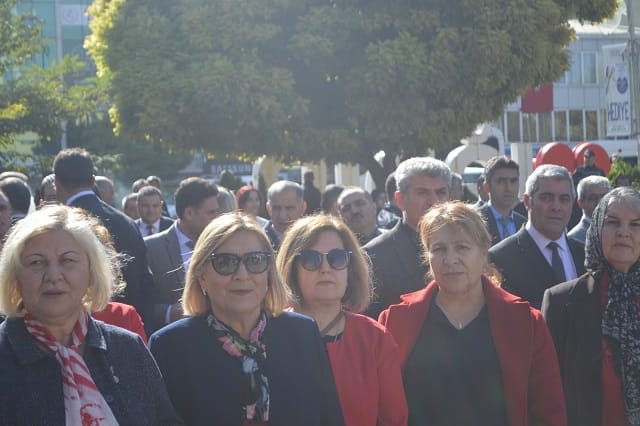
Parachute Ahmet (front) in the "Say No to Violence Against Women" march. (All participants are women.)